


Hiring a documentation SEO agency is different from optimizing a blog. Product docs must attract relevant searches without becoming inaccurate or harder to use.
The short answer: Choose an agency that understands software documentation, can diagnose technical search problems, and works with your product experts before publishing. Ask for a clear scope, verifiable work samples, and an itemized proposal. Avoid anyone promising guaranteed rankings or AI citations.
What does a documentation SEO agency actually do?
A documentation SEO agency improves how people discover, understand, and navigate software product documentation through search. This includes help centers, feature guides, integrations, API references, and troubleshooting.
Unlike general SEO, the work must protect technical accuracy while improving discovery. Our documentation SEO guide explains the underlying work; this guide helps you evaluate who should perform it.
What should you check before hiring a documentation SEO agency?
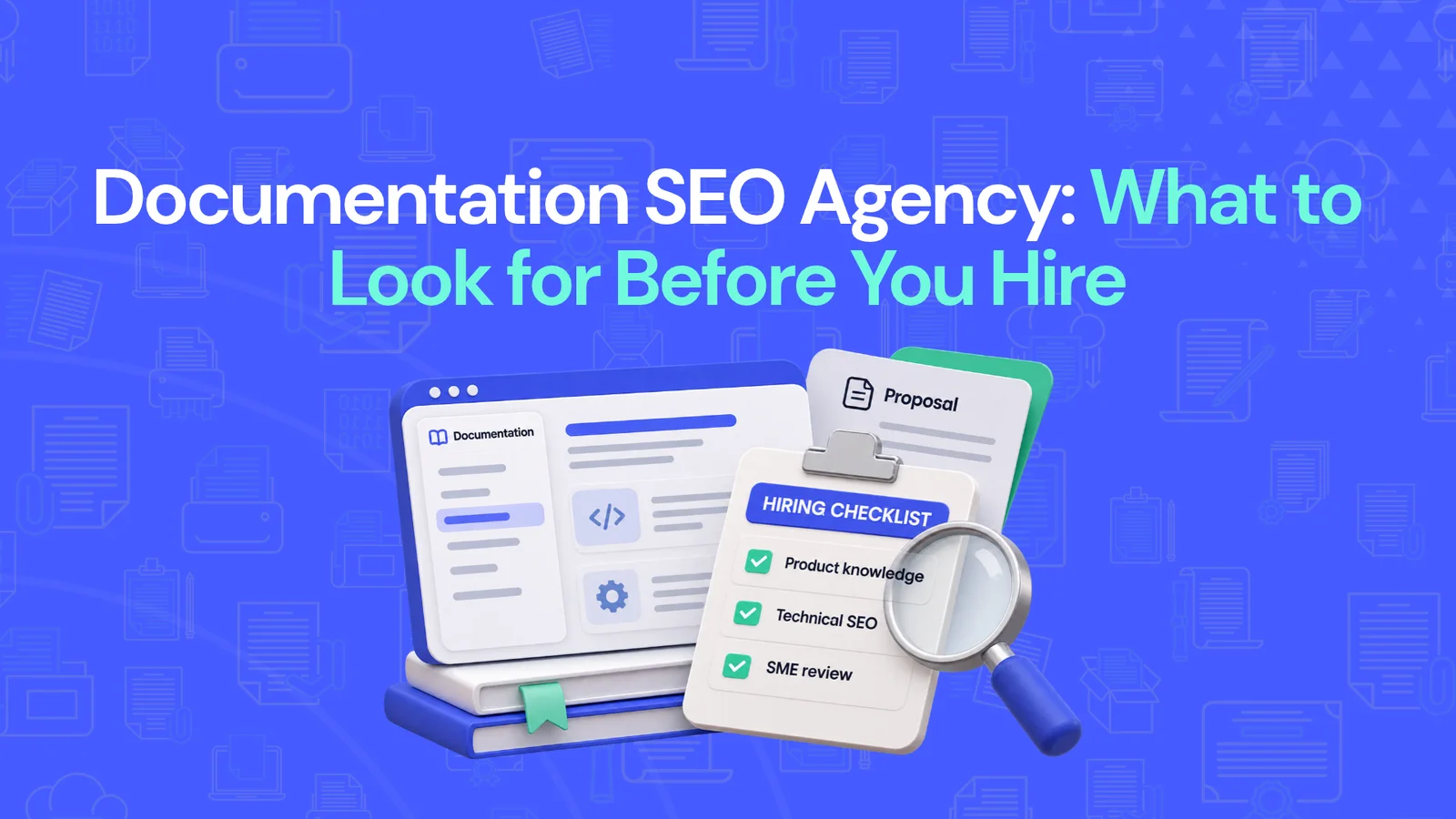
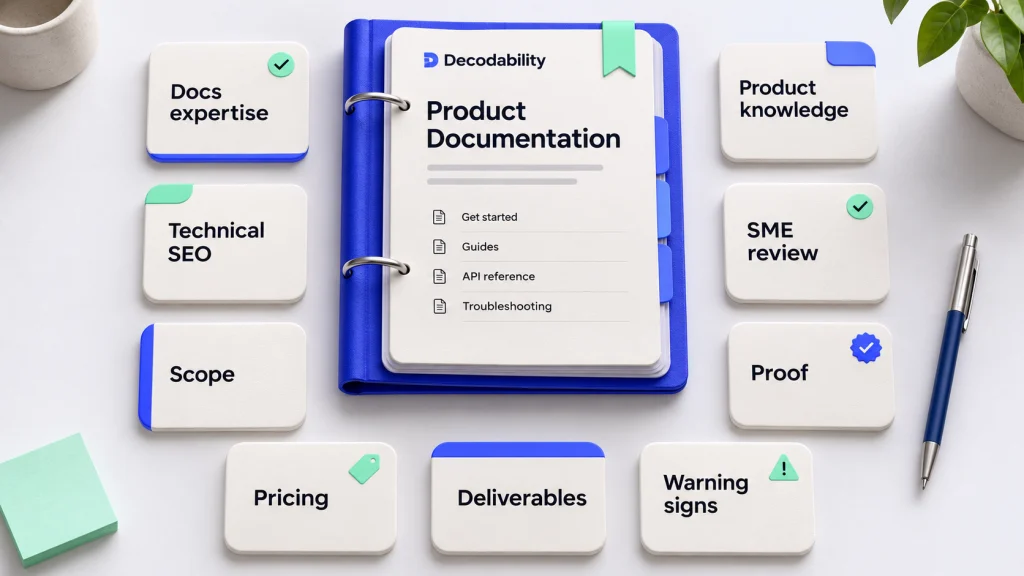
Use these nine checks to compare providers. Request evidence, not sales promises.
| Evaluation area | What to ask or request |
|---|---|
| 1. Documentation expertise | Show a reviewed feature, integration, or help-center guide, not only blog posts. |
| 2. Product knowledge | Explain how you learn our users, workflows, supported features, and limitations. |
| 3. Technical SEO | Demonstrate how you test crawling, indexing, canonical URLs, rendering, and internal links. |
| 4. SME review | Identify who checks instructions and product claims before release. |
| 5. Scope | List the pages, templates, platform work, and exclusions in the proposal. |
| 6. Proof | Share comparable before-and-after examples with dates and context. |
| 7. Pricing | Separate audit, writing, implementation, and ongoing support costs. |
| 8. Deliverables | Specify files, published pages, QA, reporting, ownership, and handoff. |
| 9. Warning signs | Explain limitations, risks, dependencies, and realistic outcomes without guarantees. |
How can you test whether an agency understands your product?
Give each shortlisted agency one real product question and ask how it would improve the relevant documentation.
For example: “Does our Shopify integration sync order events to customer segments?” A useful answer should consider supported events, permissions, setup steps, delays, and known restrictions. It should flag unknowns rather than invent capabilities.
Ask which page should answer, who reviews it, and where readers go next. This is the practical connection between product knowledge and docs as marketing.
Which technical SEO skills should a documentation specialist demonstrate?
A capable agency audits the documentation system, not just headlines. Ask it to inspect sample URLs.
- Access: Are useful public pages available without a login, unintended
noindex, or crawler blocks? - Rendering: Can Google read the main content and navigation when JavaScript is involved?
- Architecture: Do categories, breadcrumbs, and internal links help people reach related answers?
- URL management: Are canonical tags, redirects, versioned pages, and XML sitemaps handled correctly?
- Platform fit: Can the proposed changes work within your GitBook, Mintlify, Zendesk, or other documentation setup?
Google recommends crawlable links and useful, people-first content. A good provider should separate findings from changes your team can implement.
Who should approve rewritten documentation before publication?
Your product subject-matter expert (SME) should approve technical claims, examples, and instructions. The agency can improve clarity and discoverability, but it should not guess how your software works.
Agree on a named reviewer, approval steps, and release-update procedures. Request one sample page showing questions raised, corrections made, and final sign-off.
Unreviewed pages create maintenance problems, even when well written.
What proof and performance metrics should you request?
Request evidence for documentation pages, not generic traffic graphs.
A credible example should show the starting problem, changes made, publication dates, and resulting signals. Review Google Search Console impressions and clicks, relevant queries, indexed pages, documentation entrances, and measurable trial or demo journeys where tracking permits.
These metrics should fit a broader documentation-as-a-growth-channel strategy, not just a traffic report.
For AI discovery, ask how the agency checks whether selected answers cite your docs, with dates and recorded prompts. Google says its AI search features require no special optimization beyond existing Search fundamentals. Nobody can guarantee inclusion across Google, ChatGPT, Claude, or Gemini.
If a provider has limited comparable client data, ask for a redacted audit or a clearly labeled sample deliverable. Do not mistake public teardowns for proven client outcomes.
What deliverables and pricing terms should the proposal include?
The proposal should define work, responsibilities, and ownership.
| Stage | Minimum useful deliverable |
|---|---|
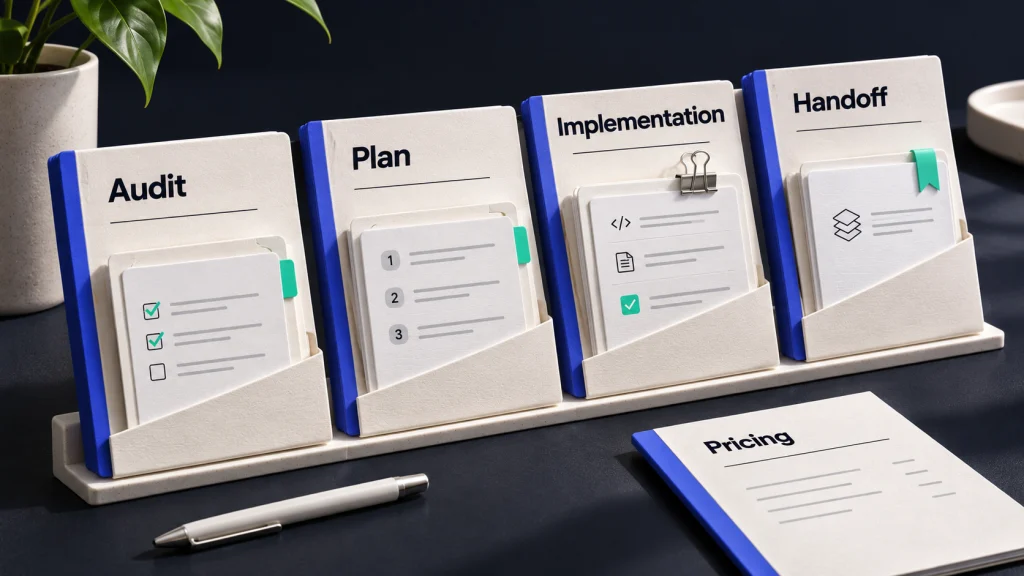
| Audit | URL inventory, priority issues, baseline, and opportunity list |
| Plan | Search-intent map, page priorities, responsibilities, and dependencies |
| Implementation | Agreed updated pages, technical tickets, SME approvals, and QA results |
| Handoff | Change log, measurement dashboard, access ownership, and next-step backlog |
Compare pricing by complexity, not only page count. An API guide requiring engineer review is different from editing a short FAQ.
Check whether the quote includes platform implementation, additional revisions, analytics setup, and follow-up monitoring. Confirm contract length, approval deadlines, payment schedule, ownership of content, and exit arrangements. A fixed-scope audit, a rebuild project, and an ongoing retainer are different purchases.
For help estimating your priorities first, review how to build a documentation-led growth strategy.
What warning signs should make you reject an agency?
Walk away or ask harder questions when a provider:
- Guarantees a number-one Google ranking or citations in AI answers.
- Sells keyword-stuffed pages without reviewing product accuracy.
- Cannot show who handles technical changes or expert approvals.
- Promises a full rebuild but lists no URLs, milestones, or exclusions.
- Reports impressions alone while ignoring qualified product actions.
- Uses vague case studies or refuses to explain what results are attributable.
Google emphasizes helpful, reliable, people-first content. A proposal built around shortcuts rather than genuine product answers deserves scrutiny.
How should you compare shortlisted agencies fairly?
Score each agency against the same evidence. This 100-point buyer scorecard is a suggested decision framework, not an industry benchmark.
| Category | Points |
|---|---|
| Documentation and product expertise | 25 |
| Technical SEO and platform fit | 25 |
| SME workflow and delivery scope | 20 |
| Proof and measurement plan | 20 |
| Pricing clarity and ownership terms | 10 |
| Total | 100 |
Award up to the listed points based on demonstrated evidence. Ask finalists for their top three documentation fixes and reasons. A serious accuracy or contract concern outweighs a high score.
Frequently Asked Questions
Is a documentation SEO agency different from a regular SEO agency?
Yes, in specialization. Documentation SEO requires knowledge of product workflows, technical instructions, documentation platforms, and SME approvals alongside standard SEO skills.
How much does a documentation SEO agency cost?
There is no universal price. Cost depends on the number and complexity of pages, technical work, product-review effort, implementation responsibility, and whether the engagement is a one-time project or retainer. Request an itemized quote.
Can a documentation SEO agency guarantee AI visibility?
No. Clear, publicly accessible documentation may help search and AI systems understand your product, but each platform decides what to retrieve, mention, or cite.
What should happen in the first 30 days?
Expect access checks, a baseline, priority URL review, product interviews, an agreed roadmap, and initial approved improvements. Timing depends on scope and reviewer availability.
Before signing: Choose the agency that can explain your product accurately, show its working process, and commit to specific deliverables. Better documentation should help real people first; search visibility is one outcome to measure, not a promise to buy.