The page answers the wrong version of the question
A heading such as “Configuration” may help someone already inside the product. A prospective buyer needs to know which feature, integration, or outcome the page explains.
Make your existing product answers easier to find through organic search, then connect interested readers to a relevant product next step.
Looking for a documentation SEO agency that understands your software? Decodability is a Documentation Growth Company for marketing and e-commerce software teams with established docs.
A product question, a useful answer
Can this tool recover abandoned carts?Connect the search to the page that explains the workflow.
What does the buyer need to know?
Can the page be crawled and indexed?
Does it explain the real capability?
Where should the reader go next?
Documentation SEO improves how search engines and readers reach, interpret, and move through your product knowledge.
It is one part of Documentation Growth, connected to product understanding and acquisition. For an existing support library, explore Help Center SEO.

A heading such as “Configuration” may help someone already inside the product. A prospective buyer needs to know which feature, integration, or outcome the page explains.
Unclear hierarchy, disconnected URLs, repeated pages, and weak internal links can make useful documentation harder to navigate and discover.
Even a strong answer can leave a buyer unsure where to explore the product, review a related workflow, or start a trial.
We work on your existing documentation, with priorities and delivery scope agreed before the rebuild.
Explore specific applications for Shopify app docs, marketing software, and e-commerce software.
We review existing pages, available Search Console and analytics data, product questions, and documentation coverage. We map relevant feature, integration, workflow, and setup searches to the pages that can answer them.
The priority is product relevance, not keyword volume alone. We identify useful pages to improve, content gaps within scope, and competing or overlapping answers.
DeliverableA documentation audit, search-intent map, and agreed page priorities.
We review hierarchy, navigation, URLs, canonical signals, indexability, crawlability, sitemaps, and internal links. Important answers need a clear place in the system and a path from other relevant pages.
Technical recommendations account for your documentation platform, access restrictions, and implementation constraints. We separate public discovery pages from account-only or sensitive guidance.
DeliverableAn approved architecture, linking plan, and prioritised technical fixes.
We rewrite agreed priority documentation with descriptive titles, direct explanations, supported capabilities, prerequisites, examples, and limitations. Feature, integration, and workflow pages answer different questions, so we give each an appropriate structure.
Product Documentation SEO and SaaS Documentation SEO both depend on accurate product detail. Your subject-matter expert reviews technical claims, screenshots, and instructions.
DeliverableRebuilt priority pages and reusable documentation templates.
A documentation reader may be an existing customer or a buyer evaluating your software. We add contextual links to related guides, integration pages, product information, trials, and demos where they help the reader.
We establish measurement and publishing checks, then review indexing, relevant search signals, and observable product-action paths. We refine the docs using available data.
DeliverableRelevant conversion pathways, launch QA, and performance observations.
Docs SEO works best when the page matches the reader's intent. These fictional examples show how we approach three common documentation types.
“Can I segment customers by purchase history?”
Show the supported conditions, how the feature works, a relevant example, and important limitations.
“Does this connect to my store?”
Explain supported data, events, prerequisites, plan requirements, and the workflows the connection enables.
“How do I recover abandoned carts?”
Describe the trigger, configuration, steps, and checks needed to build the workflow in your product.
Our managed Documentation Growth as a Service (DGAAS) model brings documentation strategy, writing, SEO, AI understanding, and conversion together in a 60-Day Documentation Transformation.
See the four-phase delivery processDecode, Structure, Rebuild, and Launch & Optimize guide the work. We agree the priority pages and technical responsibilities, substantially rebuild the core docs, then launch, monitor, maintain, and improve them throughout the engagement.
We need existing documentation, access to product knowledge, and a responsive subject-matter expert. Deliverables depend on the agreed scope and platform. Rankings, traffic, and signups are not guaranteed within 60 days.
Our independent public teardowns examine architecture, integration intent, product context, and conversion pathways. They are analyses of public docs, not client engagements or proof of results.
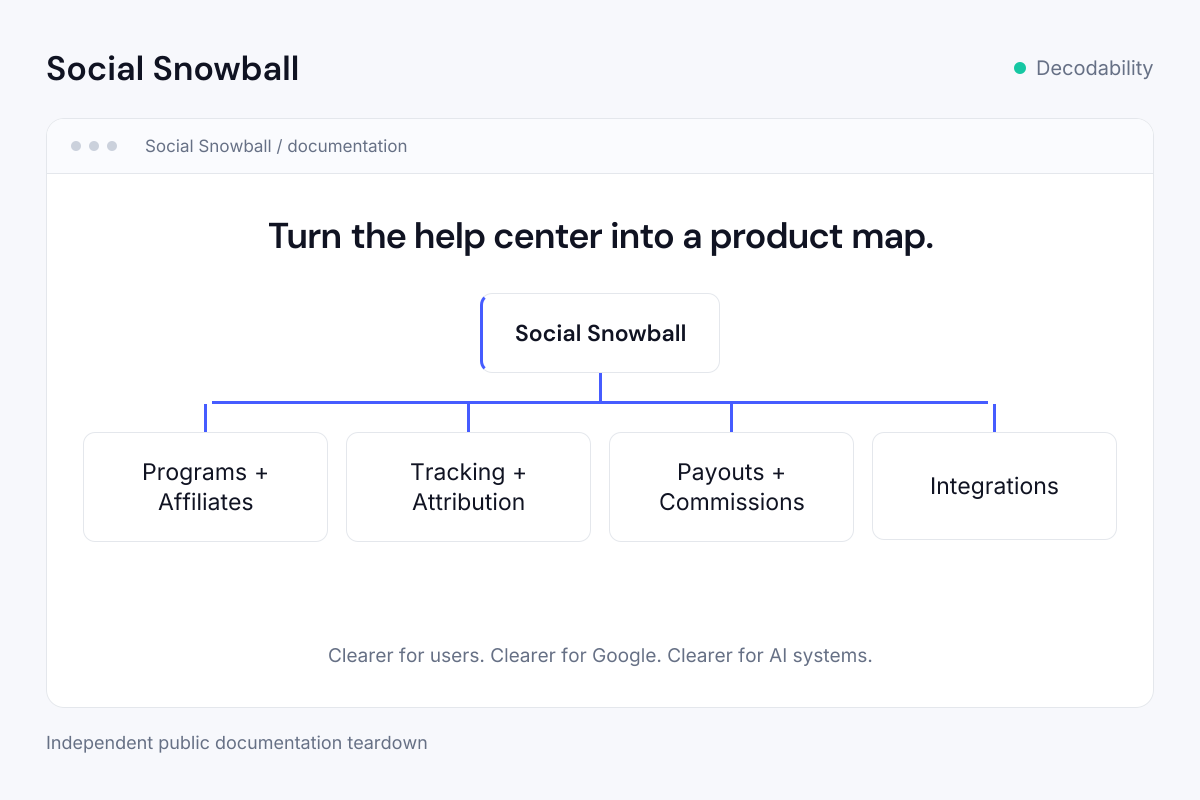
DOCUMENTATION ARCHITECTURE + UX
Social Snowball already has deep documentation across programs, affiliates, tracking, payouts, integrations, customization, and fraud protection.
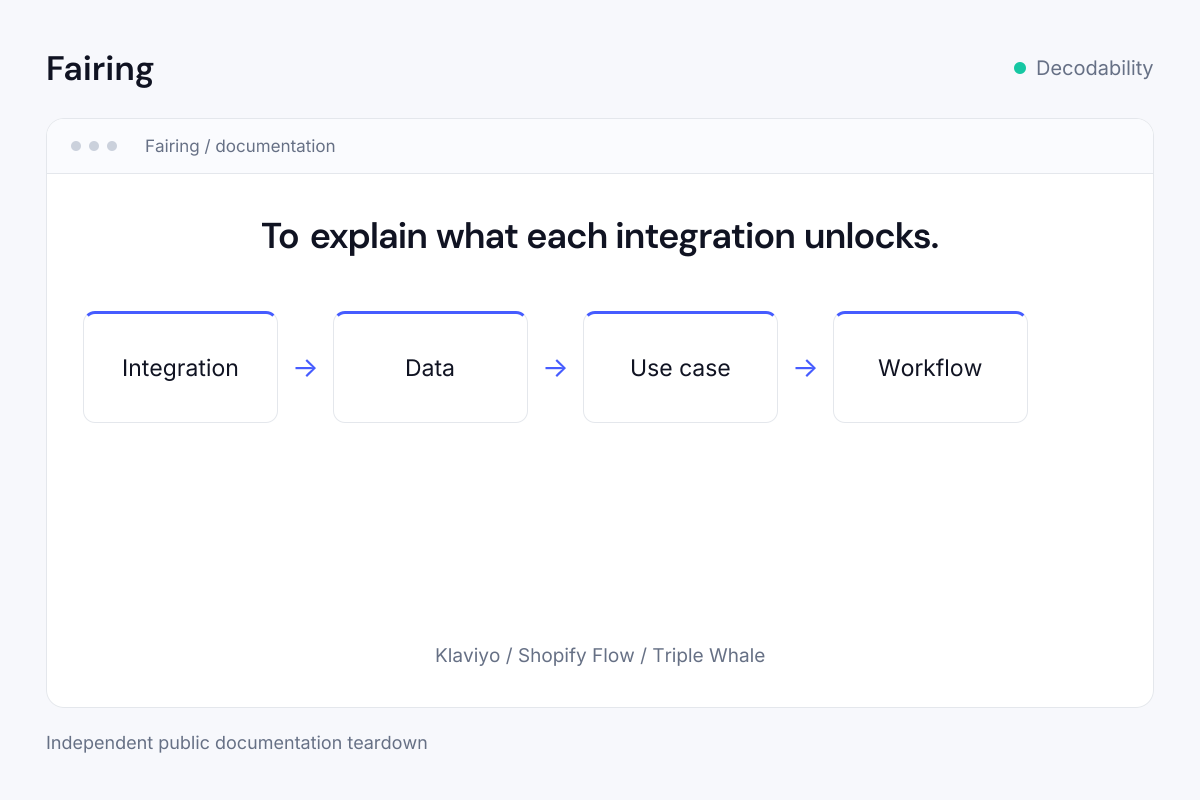
INTEGRATIONS + USE CASES + SEARCH INTENT
Fairing connects survey responses to the rest of a marketer’s stack.
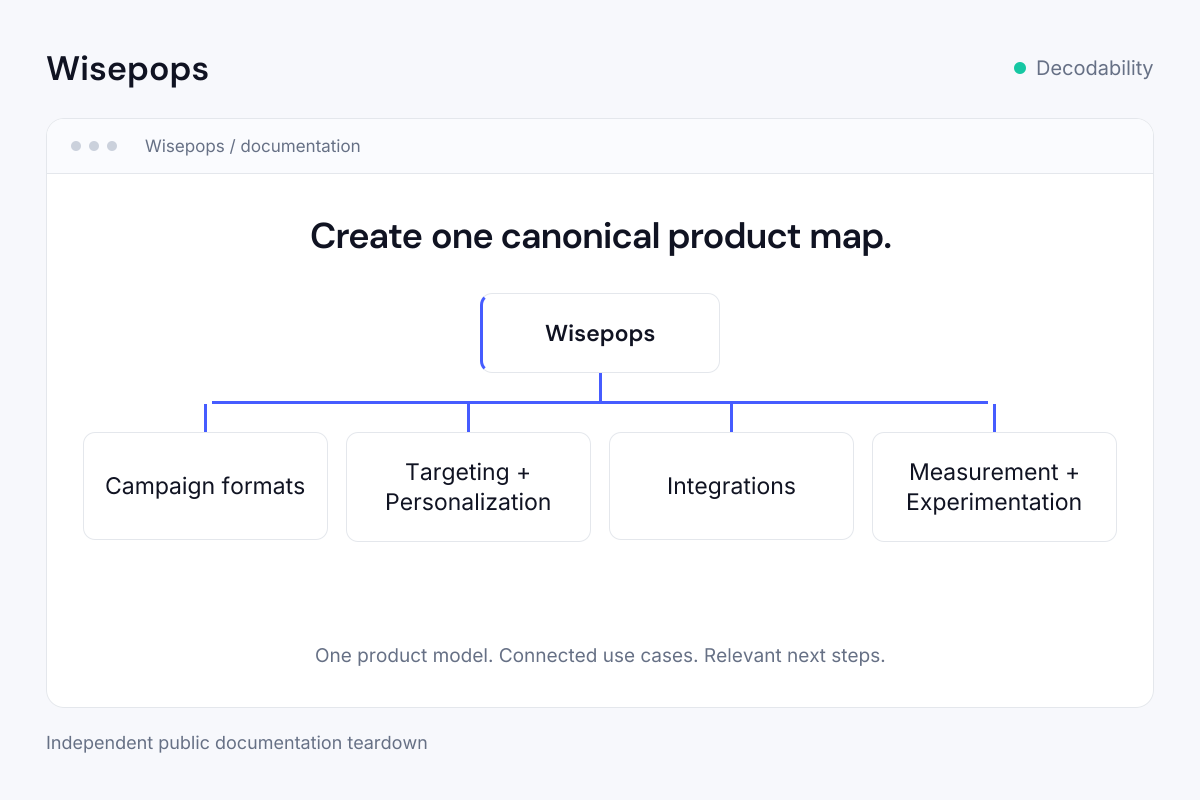
AI UNDERSTANDING + CONVERSION PATHWAYS
Wisepops already has deep documentation across popups, bars, embeds, onsite feed, web push, targeting, analytics, integrations, AI recommendations, and cart recovery.
Practical questions about fit, scope, and documentation SEO delivery. For a first check of public HTML signals, try the free Docs Discoverability Score.

Yes. We work with marketing and e-commerce software companies that already have documentation. We improve the structure and agreed priority pages, with targeted missing coverage where it belongs inside the scope.
We start with product knowledge, documentation architecture, and the questions people ask about your software. Search work is integrated with rewriting, technical accuracy, internal connections, AI readability, and useful product next steps.
We review your platform and publishing workflow during scoping. We agree what can be improved there, which technical changes need your team, and whether any platform constraints affect the work. A migration is not assumed. See our approach to GitBook SEO and Mintlify documentation.
Search and AI understanding share foundations such as accessible pages, clear product terminology, contextual links, and useful answers. Our connected approach includes those foundations; each platform still decides how it retrieves and presents information.
The scoped transformation runs for 60 days across Decode, Structure, Rebuild, and Launch & Optimize. Rebuilding, launch, monitoring, maintenance, and optimisation are included in the agreed engagement. Search results may take longer to develop.
No. We improve the documentation and conditions for discovery, then measure relevant search signals and observable product actions. Demand, competition, external platforms, the product, and attribution limits all affect outcomes.
Share your software and existing docs. We will discuss the documentation SEO opportunities, platform constraints, and scope worth exploring.