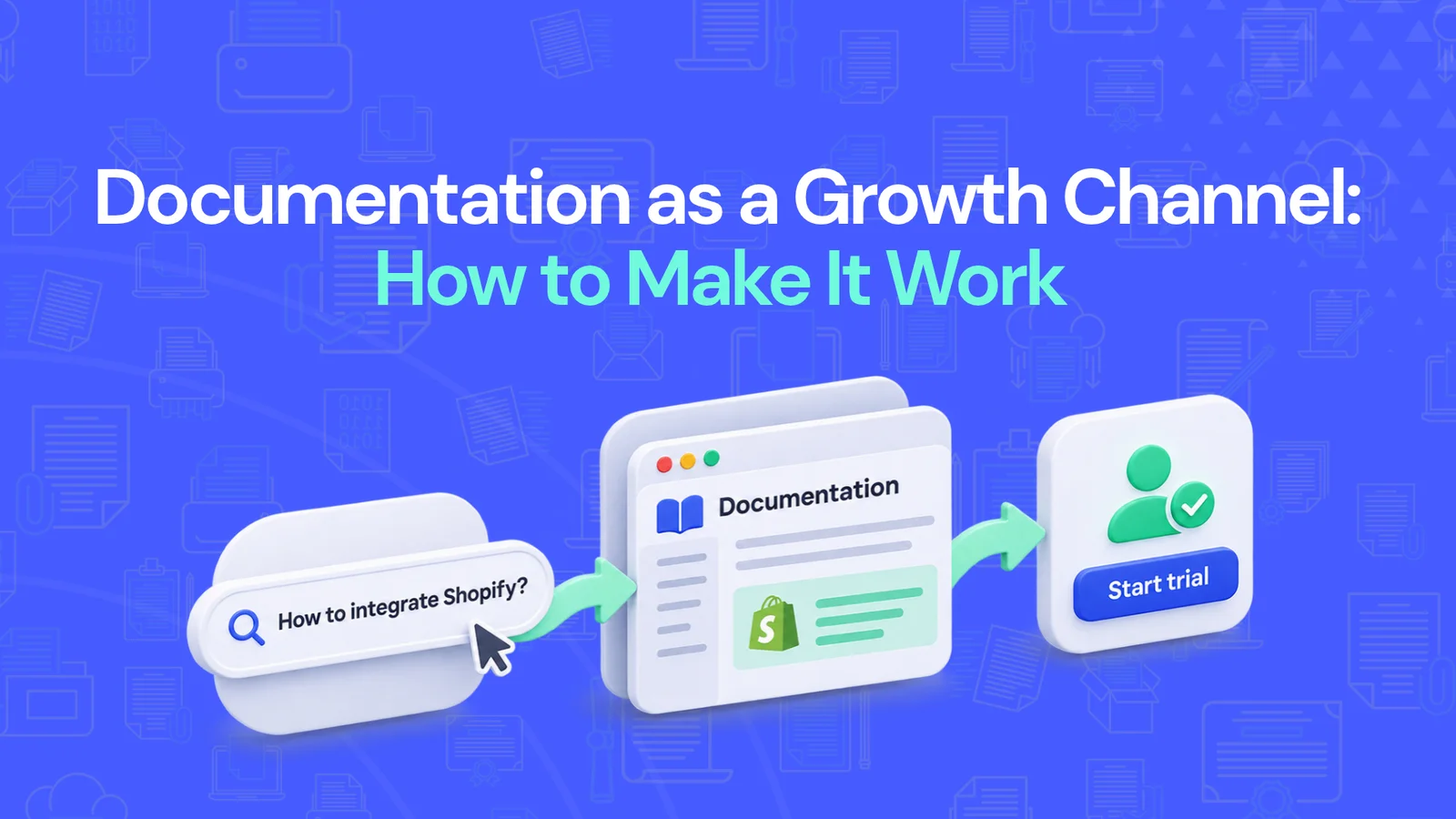



Your next customer might already be searching for something your software can do.
The problem? They may never reach your website because the answer is buried somewhere in your documentation.
Most software companies build documentation to help existing users. But those same guides, integration pages, and feature explanations can also help new buyers discover and evaluate their products.
The short answer: Documentation as a growth channel means making existing product knowledge discoverable through search engines, AI assistants, and other relevant sources. By connecting useful answers to product exploration, trials, and demos, software companies can turn documentation into an additional source of qualified acquisition opportunities.
What Does Documentation as a Growth Channel Actually Mean?
Documentation as a growth channel is a strategy that uses product documentation to attract, educate, and guide potential customers before they sign up.
Traditionally, documentation supports people who already use your software. A growth-focused approach makes that same knowledge useful to people still researching their options.
For example, someone searching for “how to automate customer win-back emails” might discover an email marketing platform through its workflow documentation rather than its homepage.
The content answers a real question while demonstrating what the product can do.
This is the idea behind documentation-led growth: connecting existing product knowledge with discovery, understanding, and acquisition.
And there is evidence that documentation matters during purchasing decisions.
The 2026 State of Docs report found that 80% of surveyed decision-makers always or often review documentation before buying.
Documentation is already part of product evaluation. The opportunity is to make it easier for prospective buyers to find.
How Can Documentation Attract Potential Customers?
Documentation can attract prospective customers through organic search, AI-assisted research, community referrals, and product evaluation.
Each channel introduces people to your software differently.
| Discovery channel | How buyers discover your docs | Typical entry page |
|---|---|---|
| Google and Bing | Search for a task, feature, or integration | How-to guide |
| ChatGPT, Gemini, Claude, and AI search | Ask whether software supports a particular workflow | Feature or integration guide |
| Communities and forums | Follow documentation linked in a useful answer | Troubleshooting or implementation guide |
| Partner directories | Explore integrations between software products | Integration documentation |
| Direct product evaluation | Review capabilities before choosing a vendor | API reference, requirements, or limitations |
These are opportunities, not guaranteed traffic sources.
For AI discovery particularly, accurate explanations, accessible pages, and consistent product information matter. Our approach to documentation for AI search focuses on making those answers easier to retrieve and understand.
The important distinction is that people do not always begin by searching for your brand. They often begin with a problem.
Which Documentation Pages Attract High-Intent Buyers?
Integration guides, feature documentation, use-case tutorials, migration guides, and technical requirements are particularly useful for capturing product-related searches.
Consider these examples for marketing and e-commerce software.
| High-intent search query | Documentation page to optimize | Buyer intent |
|---|---|---|
| “connect Shopify orders to CRM” | Shopify CRM integration guide | Integration compatibility |
| “automate emails after subscription cancellation” | Subscription automation tutorial | Workflow evaluation |
| “sync customer events with HubSpot” | HubSpot event-sync documentation | Technical feasibility |
| “migrate from Mailchimp to another platform” | Migration guide | Switching providers |
| “does this analytics tool support server-side tracking” | Tracking capabilities and limitations | Product validation |
These are illustrative queries, not verified search-volume opportunities.

A useful page should provide a direct answer, explain supported capabilities, identify prerequisites, show the workflow, and state any limitations.
This is where documentation SEO becomes important. It connects the language prospective buyers use with the actual information your documentation provides.
Prioritize product relevance over search volume. A specific integration question from a potential buyer may be more commercially useful than a broad informational keyword.
How Should Documentation Guide Visitors Toward Signup?
Documentation should connect readers to the next useful step without interrupting the answer they came to find.
A prospective buyer might follow this journey:
Google search → Integration guide → Related workflow → Product page → Free trial
For example, a Shopify merchant researching abandoned-cart automation finds a guide explaining how an email platform processes checkout events.
After understanding the integration, they follow a link to a relevant automation workflow, explore the platform’s features, and decide whether to start a trial.
The documentation helped them evaluate the product before signing up.
To support journeys like this:
- Link integration guides to related use cases and feature documentation.
- Connect technical explanations to relevant product or integration pages.
- Include contextual trial or demo links where they help readers act.
- Make navigation work in both directions between product pages and documentation.
Avoid generic calls to action on every page. A reader troubleshooting an API error needs a solution, not an aggressive sales message.
What Does Documentation Growth Look Like Before and After?
Consider a fictional email automation company that supports Shopify refund events.
Before: Documentation Built Only for Existing Users
Its documentation contains a page titled “Shopify Integration.”
The page explains how to connect an account through the settings menu. It assumes readers already have the software.
Someone searching for “how to automate emails after a Shopify refund” would struggle to understand whether the product supports that workflow.
Even if they find the page, there is no explanation of the capability or relevant next step.
After: Documentation Built for Discovery and Evaluation
The company updates its documentation with a guide titled:
“How to Trigger Automated Emails After Shopify Refund Events”
The updated page explains:
- Whether Shopify refund events are supported.
- How the event enters the automation platform.
- Which workflows can use the event.
- What permissions, plans, or limitations apply.
- Where to explore the feature or start a trial.
The page links to its Shopify integration guide, automation documentation, and product feature page.
Now, the same documentation can help an existing customer configure a workflow and a prospective buyer evaluate the software.
| Before | After |
|---|---|
| Generic integration title | Task-focused, descriptive title |
| Setup instructions only | Capability, context, and setup |
| Assumes an existing account | Answers pre-purchase questions |
| Limited related links | Connected workflow and product pages |
| No clear evaluation path | Relevant trial or product next step |
This is an illustrative scenario, not a measured case study. Better documentation creates a more useful discovery and evaluation experience, but it does not guarantee rankings or conversions.
How Can You Measure Documentation as a Growth Channel?
Measure documentation growth by tracking qualified discovery, product exploration, and observable conversions, not pageviews alone.
A practical measurement framework includes four stages.
| Stage | What to measure | Suggested tool |
|---|---|---|
| Visibility | Relevant queries, impressions, clicks | Google Search Console |
| Discovery | Organic entrances to documentation | Google Analytics 4 |
| Product exploration | Clicks to product pages, related guides, trials | GA4 events |
| Acquisition | Completed trials, demos, qualified signups | GA4 and CRM |
Google’s Search Console performance documentation explains how to analyze query and page-level search performance.
For a simple acquisition metric:
Docs landing-to-signup rate = Completed signups from tracked docs-entry sessions ÷ Eligible docs-entry sessions × 100
This measures an observable conversion path, not the complete commercial influence of documentation.
Why Is Documentation Attribution Difficult?
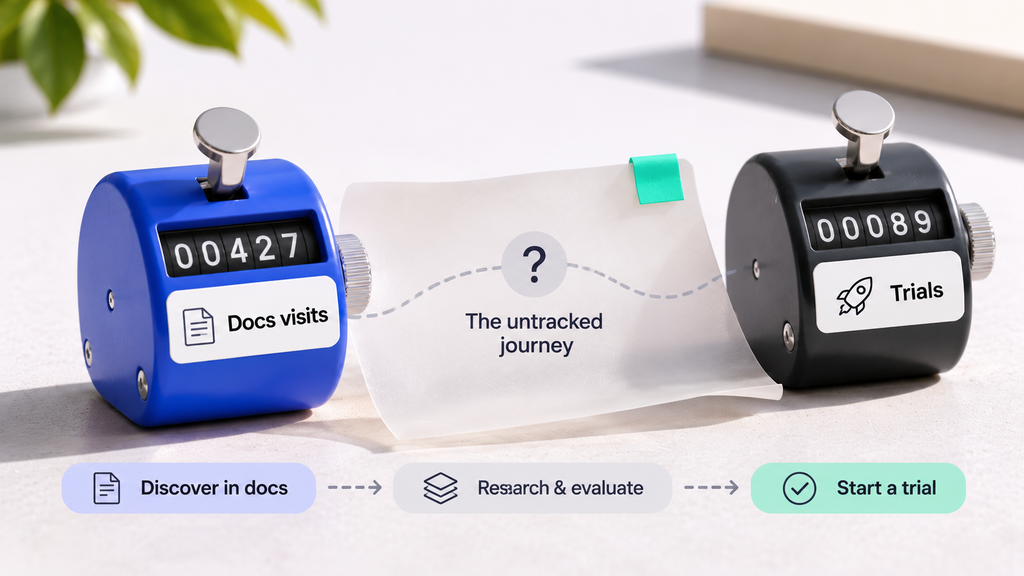
Not every documentation-influenced purchase can be traced accurately.
A buyer might read a guide, return through another channel three days later, and then sign up.
An AI assistant might explain a product using its documentation without sending a measurable website visit.
Cross-domain tracking, consent restrictions, missing referral information, and visits across different devices can also affect attribution.
Google provides cross-domain measurement guidance for connecting journeys across separate website domains.
The goal is to distinguish direct documentation conversions from assisted journeys and acknowledge what cannot be measured.
How Do You Start Turning Documentation Into a Growth Channel?
Start with your existing documentation and improve the pages closest to real buyer questions.
A practical approach involves five steps:
- Audit your documentation. Identify important guides, indexability issues, weak internal links, and missing product context.
- Research buyer questions. Use Search Console, support tickets, sales conversations, and integration requests.
- Improve priority pages. Rewrite unclear headings, add direct answers, verify capabilities, and explain requirements.
- Connect the journey. Link documentation to related guides, product pages, and relevant conversion opportunities.
- Measure and refine. Track discovery, product exploration, and completed conversions over time.
At Decodability, we bring these activities together through a structured 60-day documentation transformation for marketing and e-commerce software companies.
The objective is not simply to publish more pages. It is to make the product knowledge you already have more useful, discoverable, and connected.
Is Your Documentation Helping People Discover Your Software?
Your documentation already explains what your product can do.
But that knowledge has greater potential when prospective buyers can discover it, understand it, and use it to make a decision.
Turning documentation into a growth channel starts with connecting useful product answers to the people searching for them.
Want to see where your documentation stands? Try Decodability’s free Docs Discoverability Score to check important technical and structural signals in your existing public documentation.
Frequently Asked Questions
Can documentation really generate leads for SaaS companies?
Yes. Public, discoverable documentation can help potential buyers understand features, integrations, and requirements before signing up. Relevant links and measurable conversion paths can connect that research to trials, demos, and qualified enquiries.
Is documentation SEO different from traditional SEO?
Documentation SEO focuses on making product-specific knowledge easier to discover and understand. It uses familiar SEO fundamentals but prioritizes technical accuracy, integration questions, documentation architecture, and useful product evaluation journeys.
Can documentation help software appear in AI search results?
Yes, documentation can serve as a source of product information for AI-assisted research when systems can access and retrieve it. Clear explanations and accurate technical context can improve usefulness, but inclusion, citations, and recommendations are not guaranteed.
How long does it take for documentation to generate organic traffic?
There is no fixed timeline. Indexing, rankings, and traffic depend on competition, existing site authority, technical access, search demand, and content quality. Establish a baseline and monitor performance over time rather than expecting immediate results.
Should documentation replace traditional content marketing?
No. Blog content can introduce problems and educate potential customers, while documentation explains how a specific product solves those problems. Linking both creates a more complete discovery and evaluation experience.