


Most software companies spend time explaining their products on marketing pages, while some of their most useful answers remain buried in documentation.
But buyers need those answers before they sign up.
When documentation explains real problems, shows what a product can do, and makes the next step clear, it becomes more than a support resource.
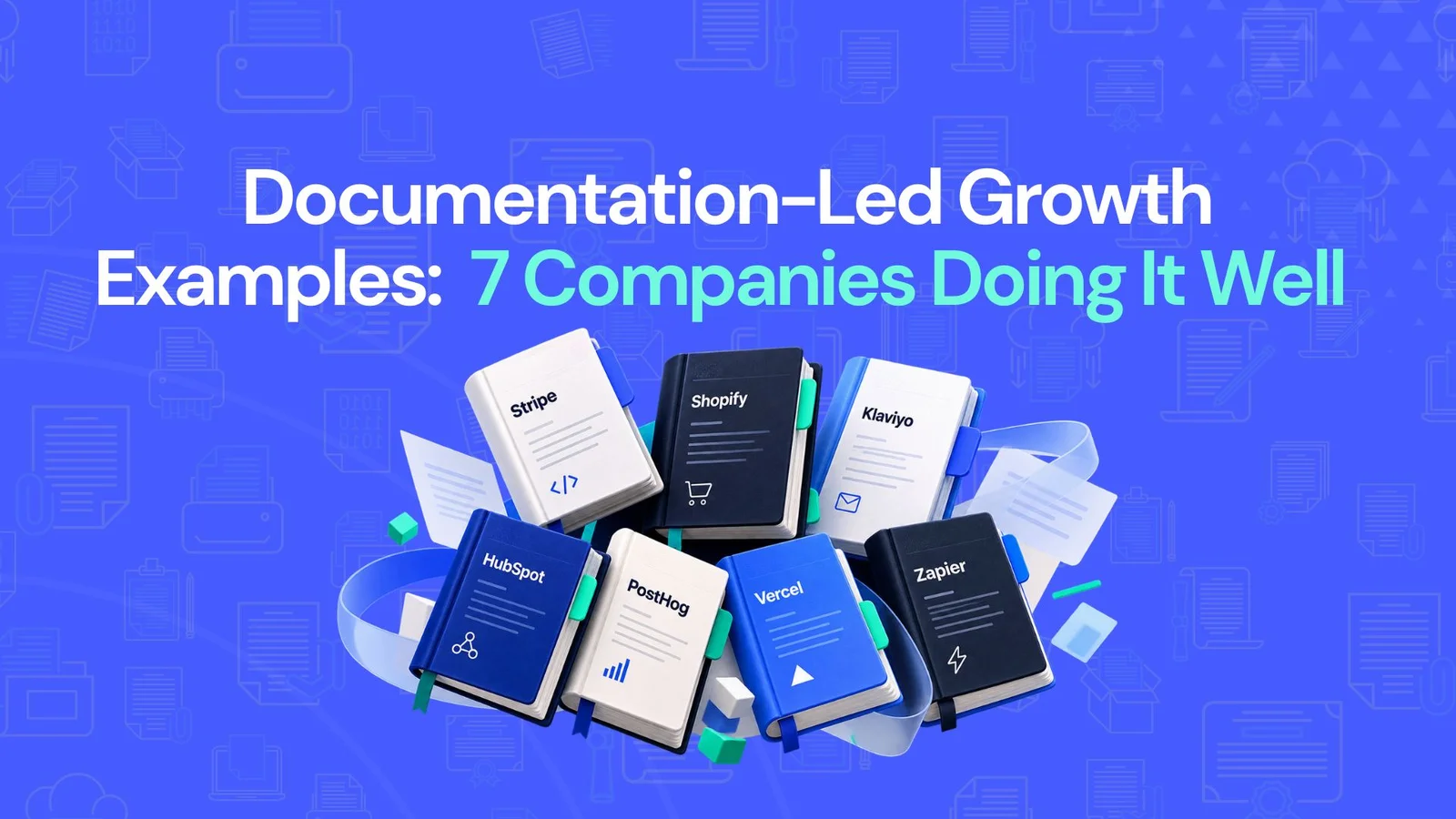
Quick answer: Seven useful documentation-led growth examples are Stripe, Shopify, Klaviyo, HubSpot, PostHog, Vercel, and Zapier. Their public resources demonstrate how structured guides, integration content, searchable answers, and clear next steps can support product discovery and evaluation.
These are observations of public documentation, not claims about revenue generated by those pages.
What Is Documentation-Led Growth, and Why Does It Matter?
Documentation-led growth is a strategy that uses public software documentation to help potential customers discover, evaluate, understand, and start using a product.
Traditional documentation primarily supports existing users. Documentation-led growth extends that value to people researching solutions.
For example, someone searching for how to automate Shopify abandoned carts might discover a Klaviyo help article before becoming a customer.
That creates an opportunity to answer a buyer’s question while demonstrating a real product capability.
The important distinction is that documentation can support acquisition without being written like an advertisement.
For a closer look at the strategy behind these examples, read our plain-English guide to documentation-led growth
Which Companies Provide Good Documentation-Led Growth Examples?
These seven companies illustrate different ways to connect documentation with a buyer’s needs.
| Company | Documentation strength | Potential buyer action |
|---|---|---|
| Stripe | Payment integration guides | Start integrating payments |
| Shopify | Developer tutorials | Build and distribute an app |
| Klaviyo | Ecommerce workflow guides | Explore marketing automation |
| HubSpot | Knowledge base and training | Evaluate CRM capabilities |
| PostHog | Platform-specific integration docs | Explore product analytics |
| Vercel | Framework-specific deployment guides | Deploy a project |
| Zapier | Integration and workflow pages | Try an automation |
We evaluated these examples across four areas: documentation structure, alignment with search questions, practical use cases, and paths toward taking action.
How Are These 7 Companies Using Documentation to Support Growth?
1. How Does Stripe Help Buyers Understand Payment Integrations?
Stripe’s documentation organizes information around practical needs, including accepting payments, managing subscriptions, and sending invoices.
Its Checkout documentation compares payment integration approaches and links to technical quickstarts.
This helps developers evaluate implementation options before committing to one.
Instead of only describing payment features, Stripe shows how to build with them.
What works: Clear product categories, task-specific pages, technical references, and links that move readers toward implementation.
Lesson: Give potential buyers enough practical information to evaluate a solution before asking them to contact sales.
2. How Does Shopify Connect Developer Documentation With Product Adoption?
Shopify’s developer documentation separates apps, storefronts, and other development paths.
Its app setup tutorial explains how to create a Shopify app using Shopify CLI, including the commands and prerequisites.
The broader documentation also connects development with app distribution through Shopify’s ecosystem.
A developer researching how to build a Shopify app can move from learning the requirements to creating a working project.
What works: Organized learning paths, specific development tasks, code examples, and links to relevant tools.
Lesson: Structure documentation around what users want to accomplish, not just your internal feature names.
3. How Does Klaviyo Turn Ecommerce Problems Into Useful Documentation?
Klaviyo’s Help Center groups information into topics such as integrations, flows, campaigns, and sign-up forms.
A strong example is its guide on creating an abandoned cart flow for Shopify.
It explains prerequisites, the Shopify event that triggers the automation, and how to select a prepared flow.
Someone evaluating abandoned cart solutions can see what Klaviyo supports and what setup involves.
The help center also provides links to training and account creation.
What works: Problem-specific guides, integration details, clear requirements, and practical setup instructions.
Lesson: Document the problems customers want to solve, not just the features your software offers.
For email, CRM, and automation platforms, documentation SEO for marketing software helps connect these practical workflow questions with relevant product guides and integration documentation.

4. How Does HubSpot Connect Documentation With the Buying Journey?
HubSpot’s Knowledge Base combines searchable product guidance with links to its Academy, community, and developer resources.
Its workflow creation guide explains how to build automations and identifies the subscription requirements.
That detail matters to someone comparing marketing automation platforms.
HubSpot also places free account and demo options within its knowledge base navigation.
What works: Searchable help content, product-specific instructions, transparent plan requirements, and relevant commercial next steps.
Lesson: Documentation should answer capability and compatibility questions before buyers need to ask your sales team.
5. How Does PostHog Use Integration Guides to Demonstrate Its Capabilities?
PostHog’s documentation separates products, libraries, integrations, and practical guides.
Its Shopify integration guide covers installing PostHog, tracking events, and measuring ecommerce conversions.
Importantly, it also explains technical limitations around Shopify checkout tracking and how custom pixels can address them.
That specificity helps a technically minded buyer understand both possibilities and constraints.
A free signup option is available through PostHog’s documentation navigation.
What works: Platform-specific guidance, implementation details, honest limitations, and a clear path to getting started.
Lesson: Answer detailed compatibility questions. Accuracy builds more confidence than broad promises.
6. How Does Vercel Make Technical Documentation Actionable?
Vercel’s documentation organizes content around deployment, frameworks, infrastructure, and developer workflows.
Its Next.js deployment guide provides CLI instructions, example projects, and deployment templates.
A developer looking for a way to deploy a Next.js application can find an appropriate guide and start the process directly.
This reduces the gap between reading documentation and trying the platform.
What works: Framework-specific content, working examples, straightforward instructions, and deployment actions.
Lesson: Connect educational content to the next useful product action whenever possible.
7. How Does Zapier Make Integrations Discoverable Before Signup?
Zapier takes a slightly different approach.
Its Shopify integration page documents supported triggers, actions, connected applications, and ready-made automation workflows.
For example, visitors can explore sending Shopify order information to Google Sheets.
The page combines practical integration information with options to start building automations.
It also makes plan requirements available, including Shopify’s premium integration status.
This is an integration catalog rather than a traditional help article, but it demonstrates how documented capabilities can serve buyer research.
What works: Integration-specific pages, searchable combinations, concrete workflows, and relevant calls to action.
Lesson: Make every important integration and use case easy to discover independently.

What Can Software Companies Learn From These Documentation Examples?
The strongest recurring pattern is simple: useful documentation connects a real question with a verifiable product capability.
To apply that approach:
- Start with buyer questions. Identify what prospects ask about integrations, compatibility, features, and implementation.
- Create focused pages. Apply documentation SEO principles so each important question has a clear answer, prerequisites, examples, and relevant internal links.
- Make the next step useful. Link to a demo, account creation, setup guide, or product page when appropriate.
- Measure the journey. Track organic documentation visits, clicks toward product actions, assisted signups, and recurring AI search citations.
These are measurable opportunities, not guaranteed outcomes.
Frequently Asked Questions About Documentation-Led Growth
What are documentation-led growth examples?
Documentation-led growth examples are public software guides, API references, tutorials, and integration pages that help potential customers understand and evaluate a product before purchasing.
Is documentation-led growth the same as product-led growth?
No. Product-led growth primarily uses the product experience to drive acquisition and adoption. Documentation-led growth uses product knowledge to support discovery, evaluation, onboarding, and activation. The approaches can work together.
Which documentation pages are most valuable for attracting buyers?
Integration guides, product use cases, compatibility articles, implementation tutorials, and API quickstarts can address questions potential buyers ask while researching software.
Can documentation help a software company appear in AI search results?
Yes, public and accessible documentation can provide relevant information for AI-powered search and answer systems. However, clear writing and structured content do not guarantee indexing, retrieval, citations, or rankings.
How Can You Turn Existing Documentation Into a Discovery Channel?
You do not necessarily need hundreds of new articles.
You need useful product knowledge organized around the questions potential customers are already asking.
At Decodability, we help marketing and ecommerce software companies restructure their existing documentation for better discoverability, clarity, and product evaluation.
Our 60-day documentation program covers research, structure, rebuilding, and launch.
our documentation already explains your product. Explore Decodability’s 60-day documentation transformation process to see how we turn existing product knowledge into a more discoverable and connected resource.