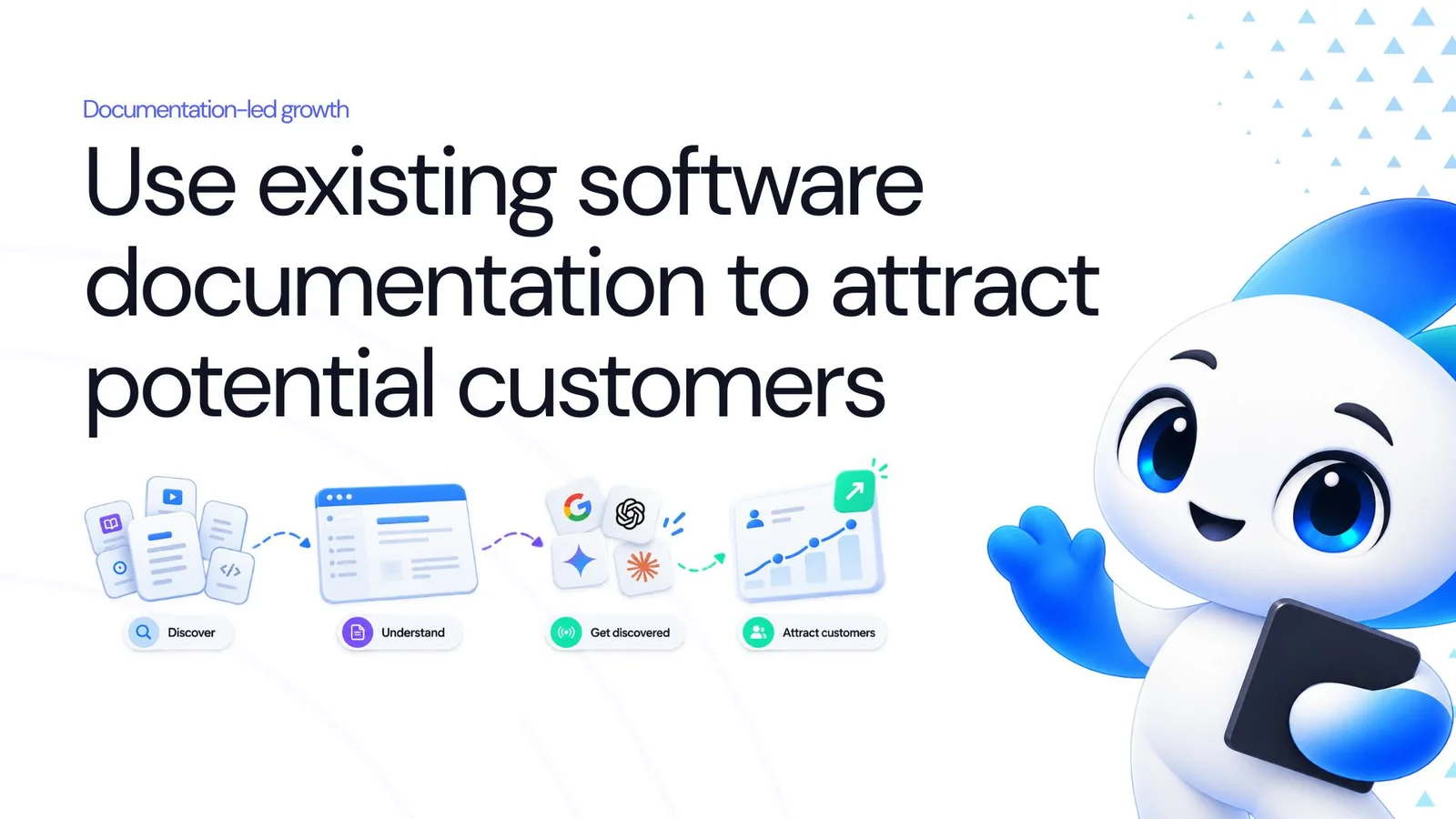
Most software companies write documentation for existing customers. Yet the same guides, tutorials, and help articles can help people discover your product before they buy.
The short answer: Documentation-led growth is a strategy that turns useful product documentation into a way for people to discover, understand, and eventually choose your software. You make docs easy to find, understand, and act on, instead of using them only for support. Docs-led growth is simply the shorter name for the same approach.
What is documentation-led growth?
Documentation-led growth means using your product’s existing knowledge to support customer acquisition as well as customer success. A public setup guide, integration tutorial, or feature explanation can help someone decide whether your software solves their problem before they ever create an account.
It does not mean turning every help article into a sales pitch. The answer comes first; a relevant next step can follow.
How does documentation-led growth attract customers?
It connects three moments in a software buyer’s journey:
- Discover. Someone searches for a task, such as “how to sync Shopify customers with email marketing.” A public, relevant guide gives them a way to find your software.
- Understand. They read the guide to learn the steps, prerequisites, supported integrations, and limitations. They can judge whether your product fits their needs.
- Choose. The guide offers a natural next step, such as trying the integration, viewing a demo, or exploring the related feature.
One helpful document can serve both a buyer and a user.
How are support-only docs different from growth-oriented docs?
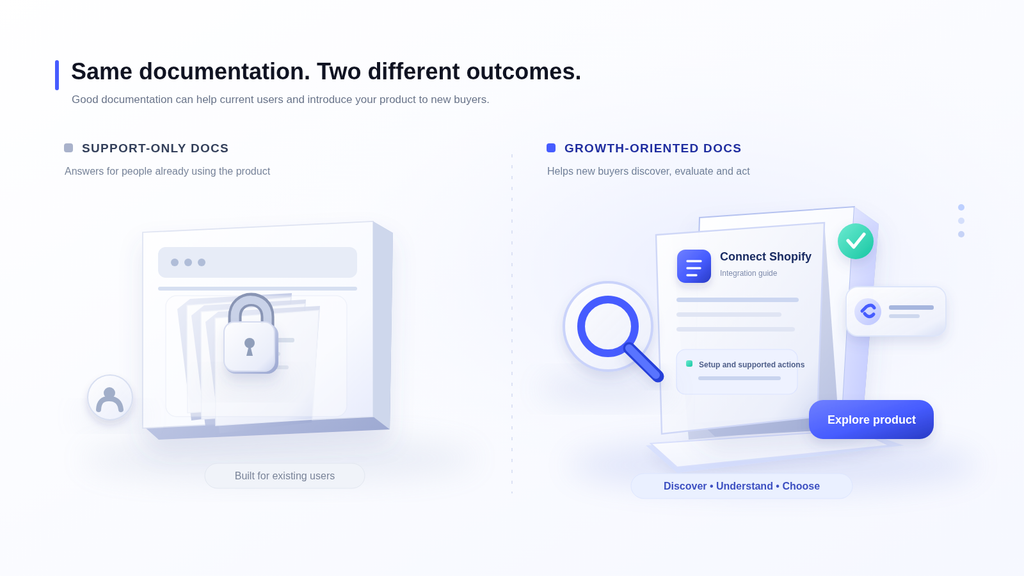
Support-only documentation usually starts with a customer who already knows your product. Growth-oriented documentation also considers people who have a problem but do not yet know your brand.
| Support-only documentation | Growth-oriented documentation |
|---|---|
| Written mainly for existing users | Useful to prospects and existing users |
| Organized mostly by internal feature names | Also organized around real tasks and questions |
| Sometimes hidden behind login | Public where safe and appropriate |
| Explains which buttons to click | Explains the outcome, steps, requirements, and limits |
| Measures views or support deflection | Also measures discovery, trial clicks, and qualified actions |
Both matter. Password-reset guides still need to be helpful, even if they never attract prospects. Docs-led growth adds a second purpose to suitable pages.
Why do Google and AI search matter for documentation?
Google, ChatGPT, Gemini, Claude, and other discovery tools can influence how people research software. Clear, publicly accessible documentation gives those systems a potential source for product facts, integrations, and use cases, although each system finds and uses sources differently.
The essentials are descriptive headings, accurate answers, internal links, and current product information. Google’s guidance for AI search features says the usual SEO foundations still apply and that no special AI-only markup is required.
A Google Research study of four cloud services examined documentation visits from over 100,000 users and found associations between the pages people viewed and later API adoption. This finding is correlational, not proof of causation.
Important: Well-structured docs may improve discoverability and understanding, but no page format guarantees a Google ranking or an AI citation.
What does docs-led growth look like in practice?
Imagine a company selling an email marketing platform for online stores. Its help center has a page called “Shopify Connector Settings.” New buyers may search differently.
The team improves the page into a guide called “How to Sync Shopify Customers With Your Email Platform.” It clearly explains what data syncs, the setup steps, prerequisites, what happens when a customer unsubscribes, and any limitations.
Customers learn the setup; prospects can evaluate the fit. A contextual link to “Try the Shopify integration” gives interested readers the next step.
The team has made existing product knowledge useful to buyers without changing the product.
Which documentation pages should you improve first?
Start with pages where someone researching a software solution might already have a question:
- Integration guides: “Does this work with Shopify, HubSpot, or Google Analytics?”
- Use-case tutorials: “How can I automate abandoned-cart emails?”
- Getting-started guides: “How quickly can I complete the first useful task?”
- Feature and limitation pages: “Does the tool support this workflow, and what are the restrictions?”
For acquisition, prioritize real problems that demonstrate proven capabilities. Keep other support pages accurate too.
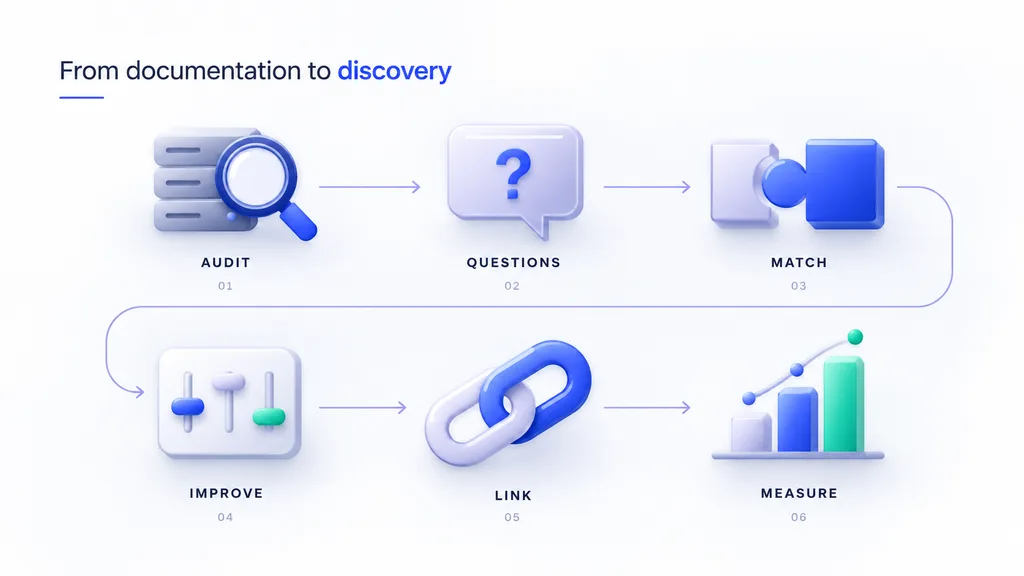
How can you start with your existing docs?
You don’t need to rewrite your help center. Start small:
- Audit what exists. List public guides and identify outdated or confusing pages.
- Collect buyer questions. Review sales calls, support questions, and Search Console queries.
- Match questions to pages. Choose five relevant documents with accurate answers.
- Improve each answer. Add clear titles, direct answers, practical steps, limitations, and related links.
- Add an appropriate next step. Offer a relevant trial, feature, or demo link without interrupting support tasks.
- Measure and maintain. Record a baseline and update guides when features change.
Before publishing, ask three questions: Can a stranger find this page? Can they understand what the product actually does? Can they take the next useful step? If the answer to any is no, the document has room to improve.
How do you measure documentation-led growth?
Measure movement toward a real outcome, not just the number of times a help page loads.
| What to measure | What it tells you |
|---|---|
| Non-branded search impressions and clicks to docs | Whether new people can discover your pages |
| Visits from docs to product, trial, or demo pages | Whether readers take a relevant next step |
| Sign-ups or demo requests after a docs visit | Whether documentation participates in acquisition |
| Activation and task completion | Whether the guides help people succeed |
| Consistent test-query visibility in AI answers | A directional signal of AI discovery, not complete attribution |
Use Search Console for organic visibility and analytics for subsequent actions. Consider seasonality; a docs visit before sign-up does not prove causation.
How is documentation-led growth different from other growth strategies?
Content marketing often attracts people through blog posts, reports, and educational articles. Product-led growth relies on the product experience itself to encourage adoption. Documentation-led growth uses accurate, practical product knowledge to help someone evaluate and succeed with that product.
They complement each other: a blog introduces the problem, docs demonstrate the solution, and a trial lets readers try it.
For marketing and e-commerce software, integrations and workflows are often central to buying decisions.
Is your documentation helping people choose your product?
Your docs may already answer prospects’ questions. Make those answers easier to find, trust, and use.
Explore more practical guides in our Documentation Growth category, or learn how Decodability helps marketing and e-commerce software companies turn existing documentation into a discovery channel through its 60-day program.
Frequently asked questions
Is documentation-led growth the same as docs-led growth?
Yes. Docs-led growth is simply shorthand for documentation-led growth. Both describe using helpful product documentation to support discovery, evaluation, adoption, and acquisition.
Can documentation generate leads without a blog?
Yes, it can. Public integration guides, tutorials, and use-case pages may attract relevant searches on their own. A blog can still help introduce broader topics and link readers to the detailed docs.
Do all help center articles need to be public?
No. Publish information that helps people and is safe to share. Keep account-specific, confidential, or security-sensitive material protected, and make sure publicly shared instructions are accurate.
How long does documentation-led growth take to work?
There is no fixed timeline. Indexing, competition, site history, and content quality all matter. Measure a small group of pages and avoid promises of immediate rankings.
Does documentation-led growth improve AI citations?
It can make product information clearer and more accessible to systems that retrieve web content, but citations are not guaranteed. Prioritize accurate, useful documentation and treat AI visibility as something to monitor, not a promised result.