PUBLIC DOCS TEARDOWN 02INTEGRATIONS + USE CASES + SEARCH INTENT
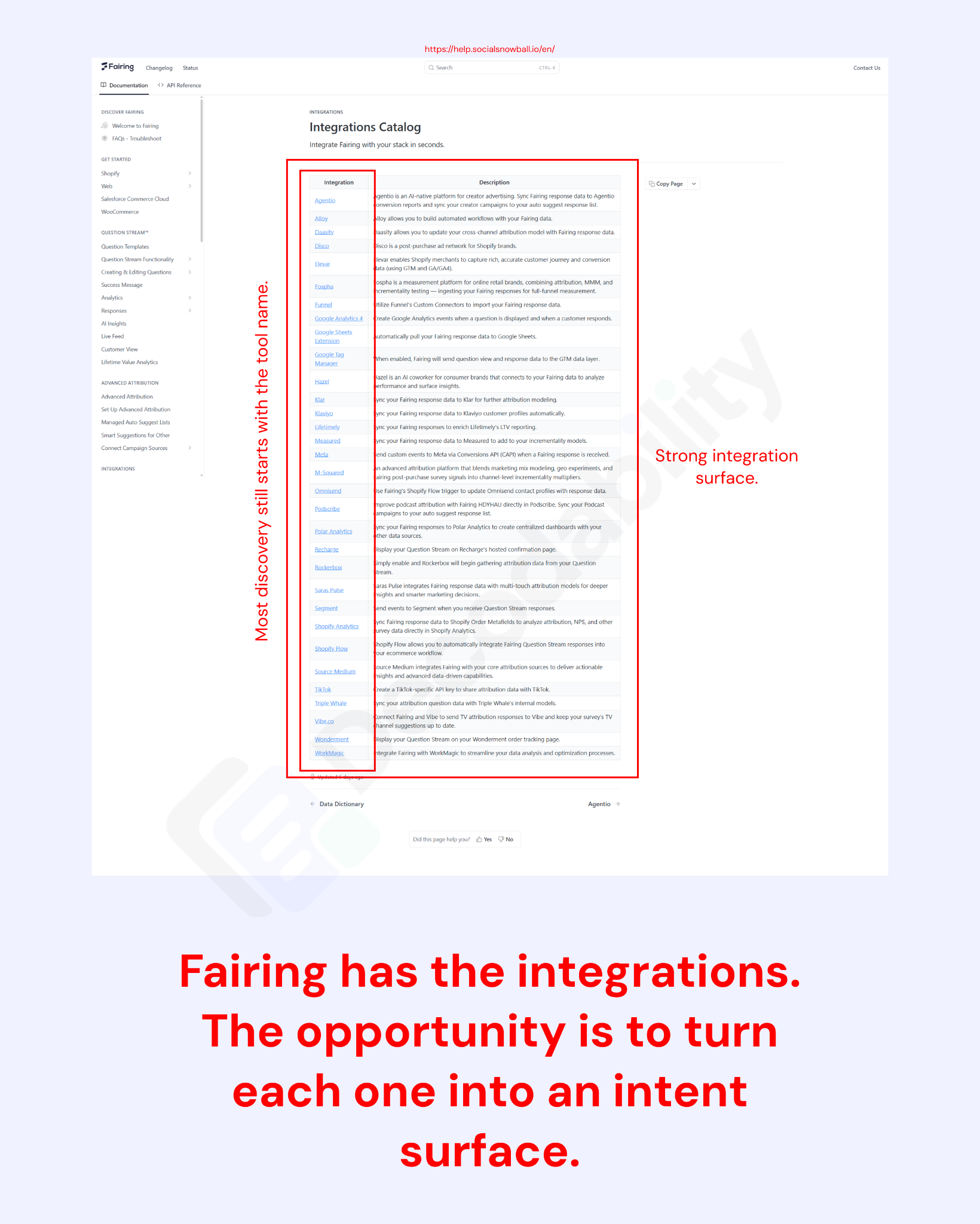
Fairing has the integrations.
The docs can capture more of the intent.
Fairing connects survey responses to the rest of a marketer’s stack.
Klaviyo. Shopify Flow. Meta. Triple Whale. Google Tag Manager. Analytics tools. Data systems.
That creates a strong documentation opportunity.
Not just to explain how each integration works.
To explain what each integration unlocks.
Setup answers how.
The stronger page also answers why.
A customer needs connection instructions.
A buyer often needs something earlier.
Will Fairing work inside the way we already operate?
That is where integration documentation can become an acquisition surface.
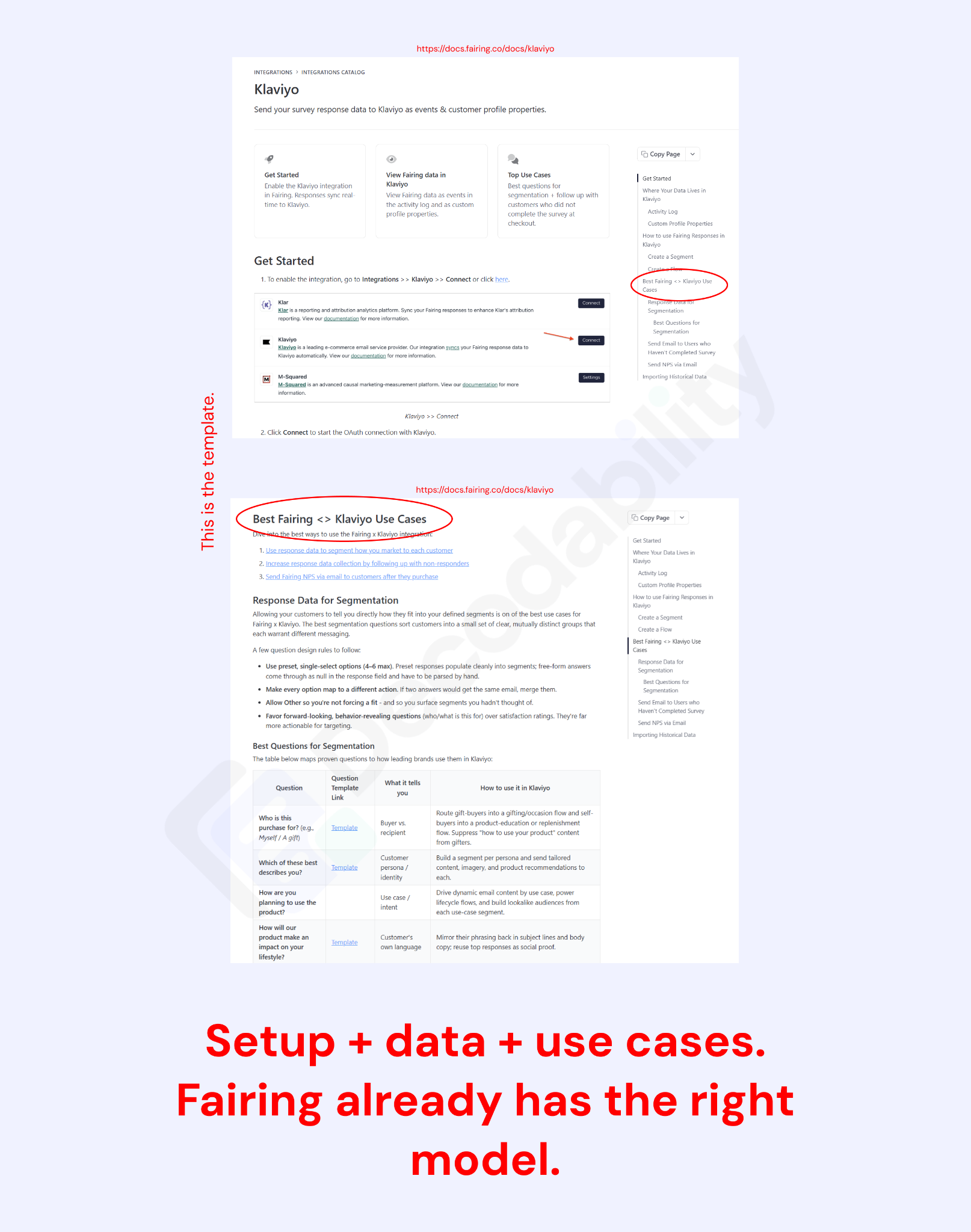
Klaviyo already shows the model.
Fairing’s Klaviyo documentation goes beyond setup.
It explains where the data lives.
How it can be used.
How marketers can build segments and flows from it.
That is the right direction.
The page connects:
- Integration
- → Data
- → Use case
- → Workflow
That makes the product relationship easier to understand before implementation begins.
Shopify Flow has more value than the page currently shows.
Shopify Flow can turn survey responses into actions across a merchant’s stack.
That is a strong product story.
The current documentation explains the connection.
The bigger opportunity is to make the workflows visible before the configuration.
The page title should explain the relationship.
Inside a docs menu:
Shopify Flow
is clear enough.
Outside the docs menu, it says very little.
A stronger page title carries the product and the outcome.
Fairing + Shopify Flow
Automate workflows from post-purchase survey responses.
The same model works across the integration library.
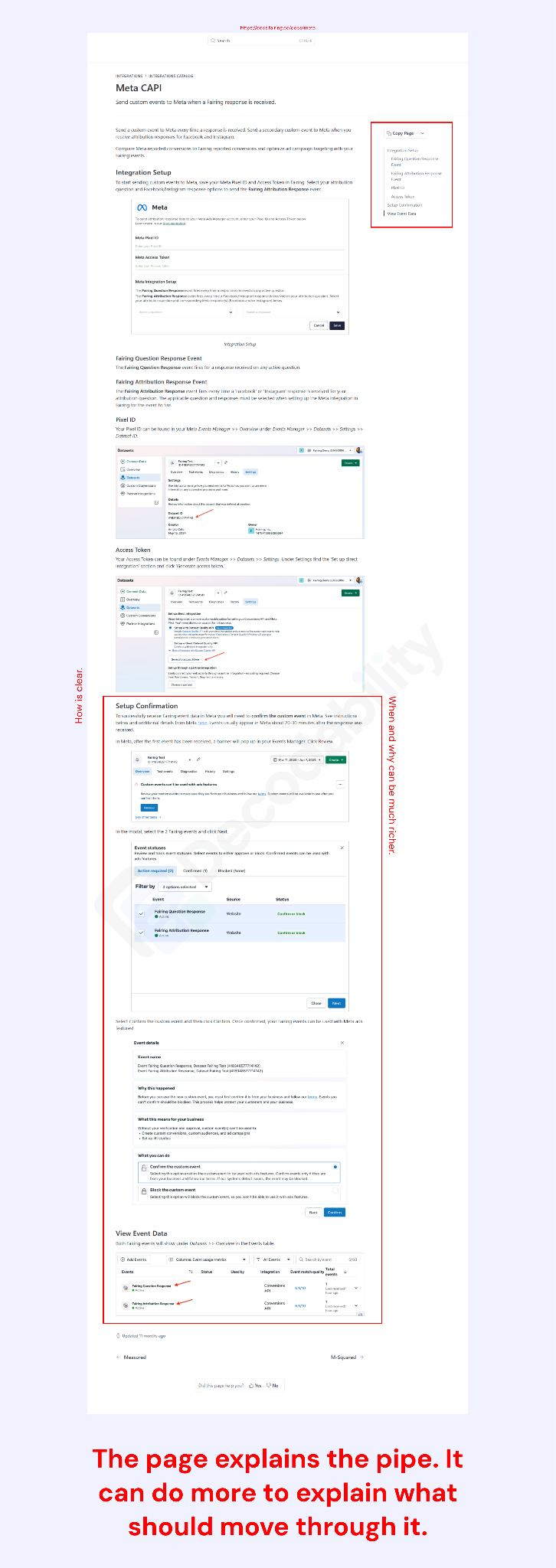
Fairing + Meta CAPI
Send survey attribution events to Meta.
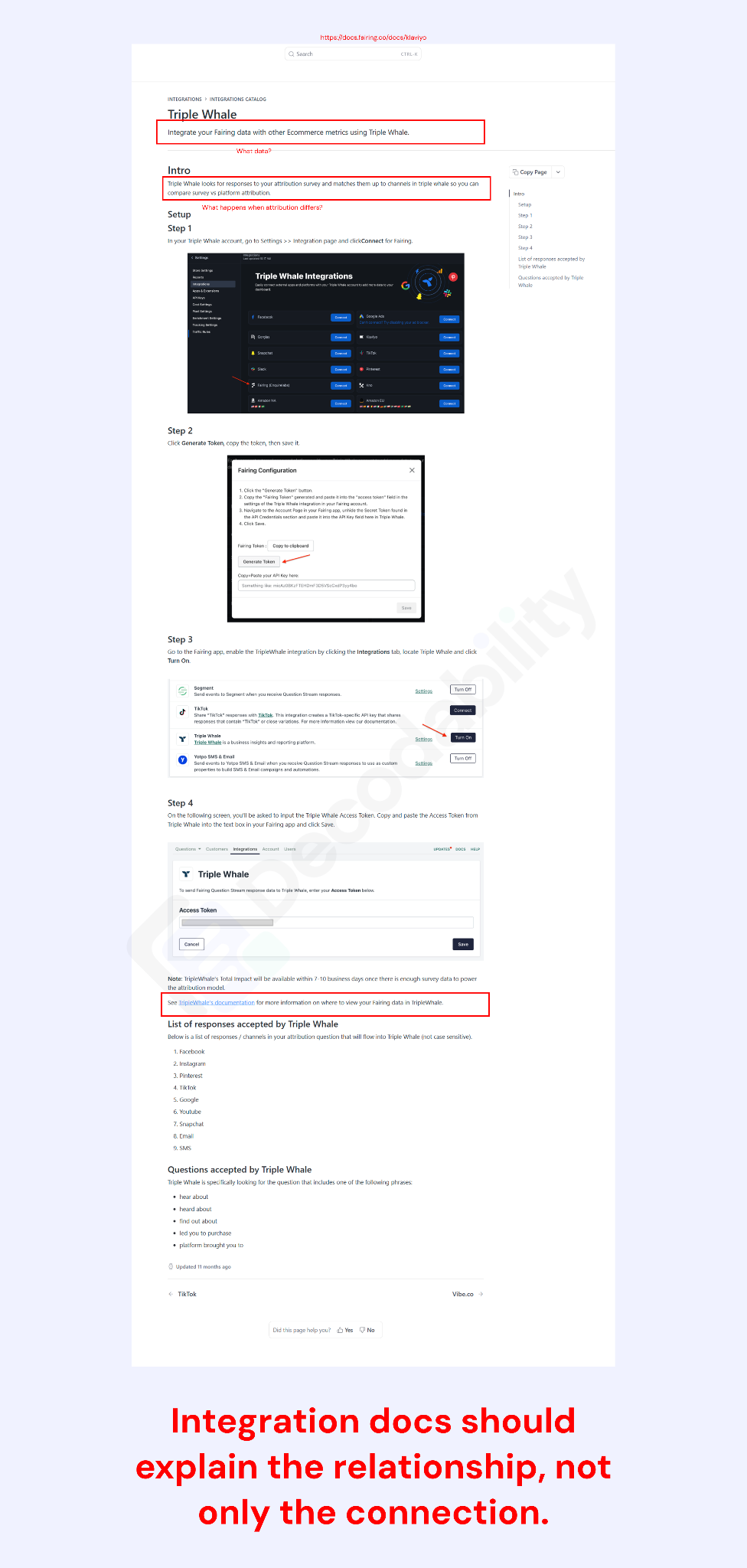
Fairing + Triple Whale
Bring post-purchase survey attribution into performance data.
Fairing + Google Tag Manager
Track survey views and responses inside the analytics stack.
The goal is not more keywords.
It is clearer product context.
High-intent questions already exist around the workflow.
- How do survey responses trigger Shopify Flow?
- Can Fairing data be used in Klaviyo segments?
- Can survey attribution be sent to Meta?
- How does Fairing work with Triple Whale?
- Can Fairing events be tracked through GTM?
- Can survey responses be pushed into a warehouse?
These are not broad content questions.
They sit close to implementation and product fit.
That is exactly where documentation-led SEO can create qualified discovery.
Every integration page can follow the same system.
01Outcome-first title
Name both products and explain the relationship.
02What the integration does
What leaves Fairing.
Where it goes.
What becomes possible.
03Best use cases
Show the workflows before the configuration.
04Setup
Keep the technical instructions clear.
05Data model
Events.
Fields.
Properties.
Timing.
Limitations.
06Worked example
Show one complete path from survey response to business action.
07Troubleshooting
Keep common failure states close to implementation.
08Related workflows
Connect the integration to adjacent Fairing capabilities.
09Next step
Give the reader the relevant product action.
Shopify Flow can become a use-case hub.
Fairing + Shopify Flow
Turn survey responses into automated ecommerce workflows.
Every time a customer answers a Fairing Question Stream question, Shopify Flow can use that response to trigger actions across Shopify and connected apps.
Use it to:
- Tag customers by acquisition source.
- Send important responses to internal teams.
- Push survey data into Sheets or a warehouse.
- Trigger lifecycle workflows.
- Route high-value responses into downstream tools.
Then move into the setup.
Why first.
How second.
Use cases create more entry points.
TAG CUSTOMERS BY ACQUISITION SOURCE
- Fairing response
- Shopify Flow
- Customer tag
MAKE CUSTOMER FEEDBACK ACTIONABLE
- Fairing response
- Shopify Flow
- Internal notification
BUILD A DATA PIPELINE
- Fairing response
- Shopify Flow
- Webhook or warehouse
TRIGGER LIFECYCLE MARKETING
- Fairing response
- Shopify Flow
- Marketing platform
The documentation starts explaining what the integration is for.
Not only how to switch it on.
Triple Whale needs the relationship, not just the connection.
A stronger attribution integration page answers:
- What does Triple Whale receive from Fairing?
- Which survey questions are useful?
- How are channels mapped?
- Why can self-reported attribution differ from click-based attribution?
- What should a marketer do when the numbers do not match?
- Where does each source add context?
Those questions help someone understand the workflow.
That is closer to product evaluation than a connection checklist.
Connect integration → use case → capability → action.
- Meta CAPI
- Attribution
- Analytics
- Next step
- Triple Whale
- Attribution
- Reporting
- Next step
- Klaviyo
- Question templates
- Segmentation
- Lifecycle workflows
- Shopify Flow
- Tags
- Sheets
- Data workflows
- Google Tag Manager
- Events
- Analytics
- Measurement
The documentation should help a reader move through the whole product relationship.
- What connects?
- What can we do with it?
- How does it work?
- What should we do next?
Do not let high-intent pages end as support-only journeys.
Integration pages often answer buying questions.
A visitor may arrive from Google.
Or an AI answer.
Or a product comparison.
They may not be a customer yet.
The next step should match that context.
For Shopify Flow:
Turn Fairing responses into actions across your Shopify stack.
For an existing customer:
Connect Shopify Flow.
For a prospective customer:
Start with Fairing and test the workflow.
One page can support both audiences.
Start with the integrations closest to product intent.
Shopify Flow
Meta CAPI
Triple Whale
Google Tag Manager
Shopify Analytics
Use the Klaviyo page as the internal standard.
Then apply the same structure across the catalog.
The opportunity
Fairing does not need more integration logos.
It needs more product understanding around each integration.
- What data moves.
- What workflow it enables.
- When the marketer should use it.
- How to implement it.
- What to do next.
That turns integration documentation into something more valuable.
- Support for existing customers.
- Discovery for potential customers.
- Clearer context for Google and AI.
- Stronger paths toward product adoption.




Built for humans.
Decodable by machines.
Decodability rebuilds existing documentation for marketing and e-commerce software companies so high-intent product knowledge is easier to discover, understand, and act on.