


Your software documentation can do more than explain how a product works. It can help potential customers discover your software, understand its capabilities, and decide whether it solves their problems.
If you’re new to the concept, start with our plain-English guide to documentation-led growth to understand how documentation can support customer acquisition.
But turning documentation into a growth channel requires more than publishing help articles.
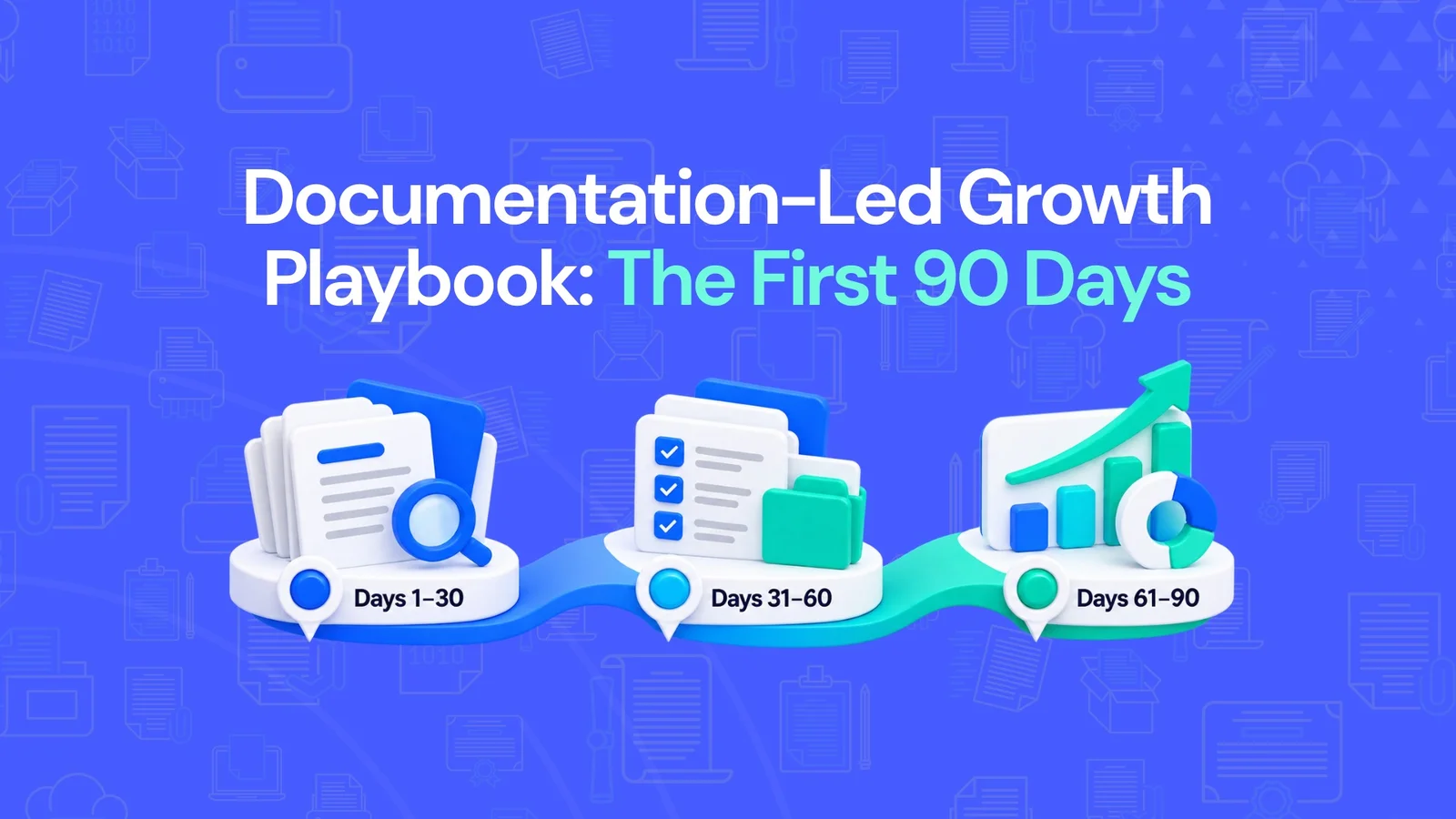
TL;DR: A documentation-led growth playbook is a structured plan for turning product documentation into an organic acquisition channel. Over 90 days, software teams can establish a baseline, identify search opportunities, prioritize content, improve documentation structure, publish useful guides, distribute them, and measure performance across traditional and AI-powered search.
What is a documentation-led growth playbook?
A documentation-led growth playbook is a repeatable strategy for using product guides, integration instructions, API references, and help center content to attract and convert potential customers.
Traditional documentation primarily serves existing users. Growth-focused documentation also answers questions people ask before choosing a product.
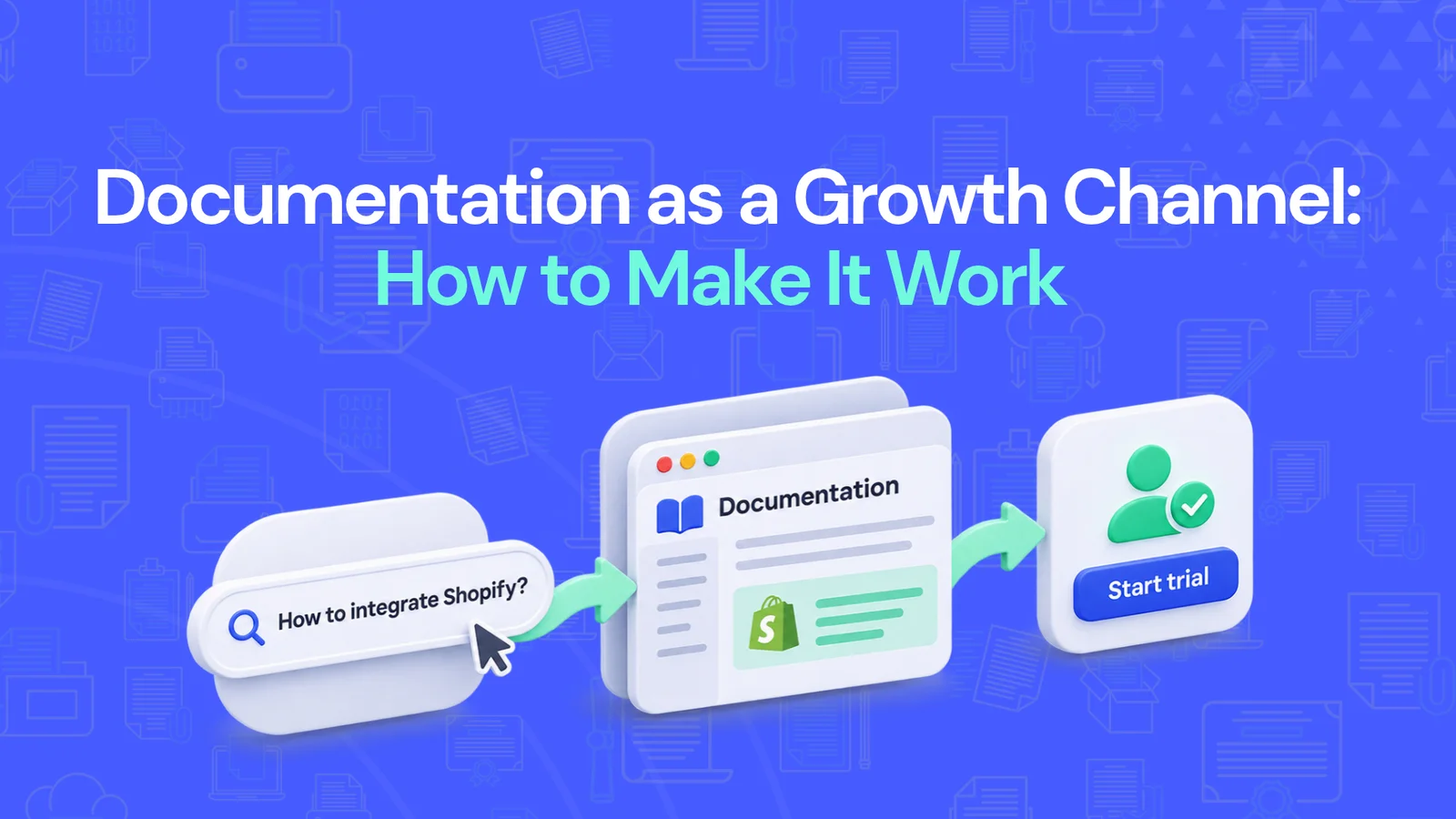
For example, someone searching for “how to sync Shopify customers with an email marketing platform” might discover your integration guide before discovering your homepage.
That documentation can introduce your software through a problem the visitor already wants to solve.
The principle is simple: Solve the user’s problem first, demonstrate your product’s capabilities second, and make the next step easy.
This approach combines documentation SEO, content strategy, product education, and conversion optimization.
What should you do during the first 90 days?
The first 90 days should focus on building a repeatable documentation growth process, not simply increasing the number of published pages.
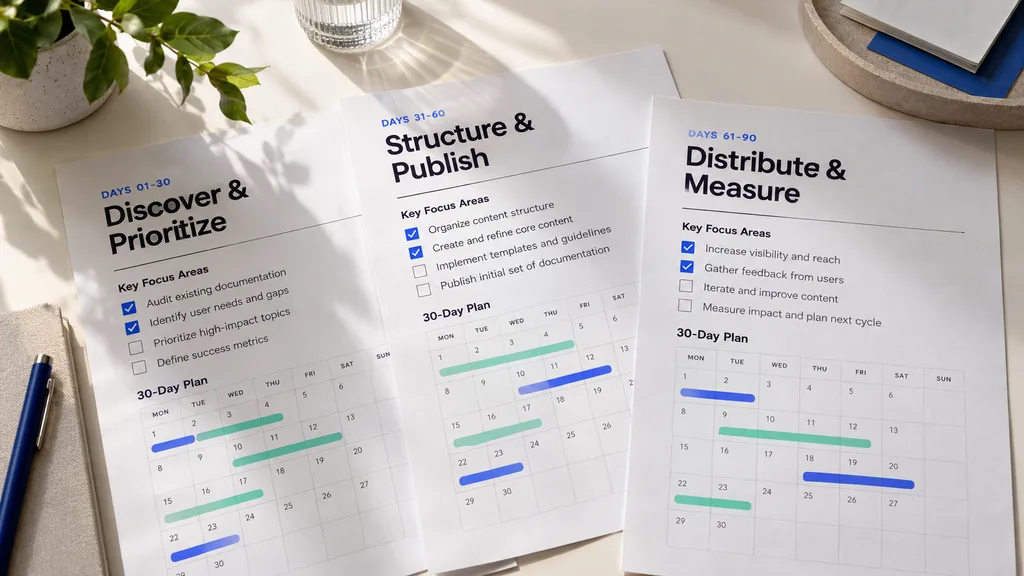
Here is a practical seven-phase operating plan.
| Timeline | Focus | Expected deliverable |
|---|---|---|
| Days 1-10 | Establish baseline | Documentation performance report |
| Days 11-20 | Find opportunities | Search opportunity map |
| Days 21-30 | Prioritize | Ranked content backlog |
| Days 31-45 | Restructure | Improved documentation architecture |
| Days 46-60 | Publish | First wave of optimized pages |
| Days 61-75 | Distribute | Distribution and internal linking plan |
| Days 76-90 | Measure | Performance report and next-quarter roadmap |
How do you establish a documentation baseline in Days 1-10?
Start by understanding how your existing documentation performs before making changes.
Use Google Search Console, Google Analytics 4, and your documentation platform to examine:
- Organic impressions, clicks, and search queries.
- Indexed and non-indexed documentation pages.
- Visitors reaching docs from external searches.
- Clicks from documentation to product or signup pages.
- Outdated, duplicated, or difficult-to-find content.
Separate branded searches from non-branded searches wherever possible.
Someone searching for your product name already knows your brand. Someone searching for a specific workflow may represent a new acquisition opportunity.
Deliverable: A baseline spreadsheet containing page URLs, topics, traffic, search visibility, conversions, and identified problems.
How do you discover documentation growth opportunities in Days 11-20?
Find opportunities by identifying questions potential customers ask that your documentation does not answer well.
Review five information sources:
- Search Console: Identify relevant queries with impressions but limited clicks.
- Customer support: Find frequently repeated product questions.
- Sales conversations: Collect integration, feature, and implementation questions from prospects.
- Competitor documentation: Identify useful topics your documentation currently misses.
- Search and AI assistants: Explore how Google, ChatGPT, Claude, and Gemini answer relevant product questions.
For a marketing software company, opportunities might include Shopify integration instructions, customer segmentation workflows, or troubleshooting data synchronization.
Group opportunities into discovery, evaluation, and implementation intent.
For AI-specific opportunities, understanding documentation for AI search can help teams make accurate product information easier for AI-powered search systems to retrieve and interpret.
Deliverable: A topic map connecting customer questions, existing documentation, missing pages, and potential business value.
How do you prioritize documentation in Days 21-30?
Prioritize documentation based on business relevance, search opportunity, confidence, and implementation effort.
Not every documentation page deserves equal investment.
A practical editorial scoring model is:
Priority Score = (Search Opportunity × Product Relevance × Confidence) ÷ Effort
Rate each factor from 1 to 5. This is a suggested internal prioritization framework, not an industry benchmark.
For example, a Shopify integration guide with scores of 5, 5, 4, and 2 receives a priority score of 50.
A general account-settings article may have much lower acquisition potential, even though it remains important for customer support.
Focus first on pages that solve meaningful problems and naturally demonstrate your product’s value.
Deliverable: A ranked backlog with target queries, content owners, and publishing priorities.
How do you restructure documentation in Days 31-45?
Restructure documentation around the tasks users want to complete rather than only your product’s internal feature names.
A clear structure might look like this:
- Getting Started
- Features and Workflows
- Integrations
- Use Cases
- Troubleshooting
- API and Developer Guides
Connect related pages so visitors can move naturally from understanding a capability to implementing it.
For example:
Shopify Integration Overview → Connect Shopify → Sync Customer Data → Troubleshoot Sync Issues
Use descriptive headings, consistent URLs, logical navigation, and contextual internal links.
These improvements are also central to documentation SEO, which helps search engines discover, crawl, and understand your product documentation.
Google’s link best practices explain how crawlable links and meaningful anchor text support page discovery.
Deliverable: A revised documentation sitemap, navigation structure, and internal linking plan.
How do you publish growth-ready documentation in Days 46-60?
Publish documentation that answers a specific question clearly and demonstrates how the product solves it.
Use this repeatable page structure:
- Clear title: Describe the task in the user’s language.
- Direct answer: Explain the outcome immediately.
- Requirements: List prerequisites or permissions.
- Instructions: Provide accurate, numbered steps.
- Visual proof: Include current screenshots or examples.
- Troubleshooting: Address common errors.
- Next action: Link to a related workflow or relevant product page.
Have someone familiar with the product test important instructions before publication.
Make public acquisition-focused pages accessible to search crawlers, while keeping private or sensitive information protected.
Google’s people-first content guidance emphasizes original, trustworthy, genuinely useful information.
Deliverable: An initial batch of reviewed, published documentation pages with relevant internal links and conversion paths.
How do you distribute documentation in Days 61-75?
Distribute published documentation through channels where your audience already asks questions.
Useful distribution opportunities include:
- Product onboarding emails.
- Sales follow-ups and demo resources.
- Relevant LinkedIn educational posts.
- Integration partner resources.
- Existing blog articles and feature pages.
- Customer support responses and community discussions.
For example, a Shopify integration guide can support a blog tutorial, a sales conversation, and an onboarding email without creating three separate explanations.
Avoid posting documentation links where they do not genuinely answer the discussion.
Deliverable: A distribution calendar recording each page, channel, owner, and publication date.
How do you measure and improve documentation in Days 76-90?
Measure whether documentation is becoming easier to discover and helping visitors take meaningful actions.
Compare performance against your initial baseline using consistent periods.
Review search impressions, non-branded clicks, relevant query coverage, documentation-to-product clicks, and attributable signups.
Test representative prompts in AI search tools to observe whether your content is being referenced. Record the prompt, date, platform, and citation. These checks are directional because AI-generated answers can change.
Improve underperforming pages by correcting search intent mismatches, strengthening examples, updating screenshots, or improving internal links.
Deliverable: A 90-day performance review and a prioritized roadmap for the following quarter.
How should you measure documentation-led growth?
Measure documentation-led growth through visibility, engagement, and business outcomes, rather than traffic alone.
| Metric | What it tells you |
|---|---|
| Non-branded organic clicks | Whether new audiences discover your docs |
| Relevant search impressions | Whether visibility is expanding |
| Documentation-to-signup clicks | Whether readers take the next step |
| Docs-influenced signups | Whether documentation contributes to acquisition |
| AI search references | Whether monitored AI answers mention or cite your pages |
| Documentation accuracy | Whether content remains useful and reliable |
Use Google Search Console for search performance and GA4 events for measurable user actions.
A useful conversion metric is:
Documentation CTA Click Rate = (CTA Clicks ÷ Documentation Sessions) × 100
Set targets using your actual baseline rather than arbitrary industry averages.
Remember that 90 days is an operating milestone, not a guarantee of rankings or revenue. Search visibility and acquisition results may take longer to develop.
How is the 90-day plan different from Decodability’s 60-day program?
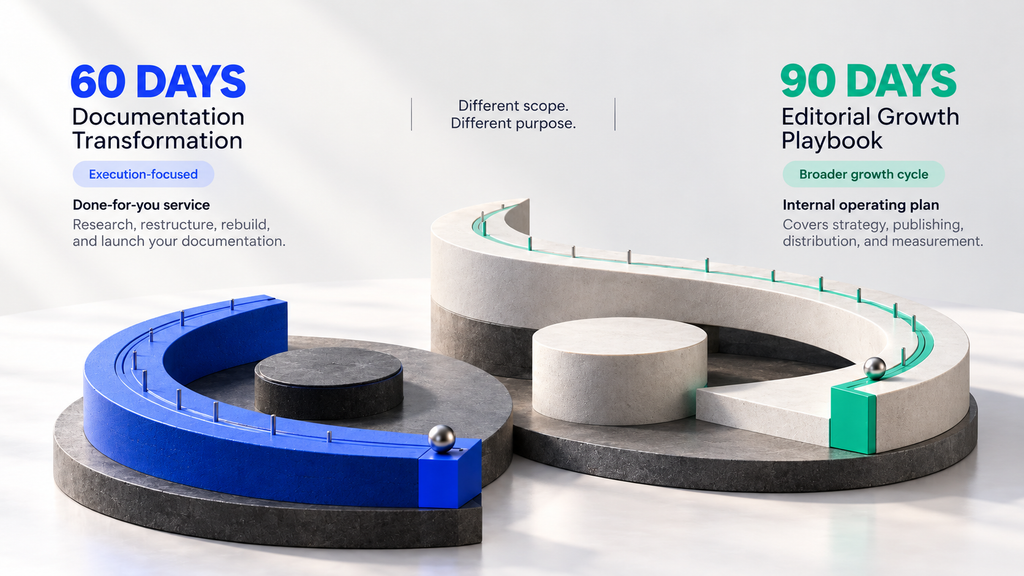
The 90-day documentation-led growth playbook is a broader editorial and marketing operating plan. Decodability’s 60-day documentation transformation process is a focused delivery model for researching, restructuring, rebuilding, and launching growth-ready documentation.
Decodability organizes its delivery into four phases:
| Decodability phase | Timeline | Primary focus |
|---|---|---|
| Decode | Days 1-5 | Research and evaluate opportunities |
| Structure | Days 6-14 | Plan documentation architecture |
| Rebuild | Days 15-30 | Improve and rebuild documentation |
| Launch | Days 31-60 | Launch, monitor, and make improvements |
The two timelines serve different purposes.
The 60-day model focuses on implementation and launch. The 90-day playbook includes the wider editorial cycle, distribution, performance evaluation, and ongoing planning.
They can overlap, but the 90-day editorial plan should not be interpreted as an extension of Decodability’s 60-day service.
What mistakes should you avoid?
Avoid treating documentation-led growth as a content-volume exercise.
Common mistakes include:
- Publishing keyword-focused articles without validating product accuracy.
- Optimizing only for Google while ignoring real customer questions.
- Keeping useful public guides disconnected from product pages.
- Measuring pageviews without tracking meaningful actions.
- Expecting AI citations or organic rankings immediately.
- Publishing documentation without assigning someone to maintain it.
The best documentation growth strategy combines technical accuracy, useful content, discoverability, and continuous improvement.
Frequently Asked Questions
Can documentation really generate new customers?
Yes. Public documentation can attract potential customers searching for specific workflows, integrations, or product capabilities. Relevant links to product pages and signup experiences can turn those visits into acquisition opportunities.
How many documentation pages should we publish in 90 days?
There is no universal target. Start with your highest-priority opportunities. Five accurate, well-connected guides may be more valuable than dozens of low-quality pages.
Do we need separate documentation for Google and AI search?
Not necessarily. Google recommends established SEO practices, accessible content, and original information for both traditional and AI-powered search. No special AI-specific markup is required for Google’s AI search features.
How long does documentation-led growth take to show results?
Results vary depending on existing authority, competition, indexing, content quality, and distribution. Use 90 days to establish a measurable process, then continue reviewing performance over subsequent months.
Does FAQ schema improve documentation visibility?
FAQ structured data can describe question-and-answer content, but Google discontinued FAQ rich results in May 2026. Adding FAQ schema does not guarantee better rankings, rich results, or AI citations.
Ready to turn documentation into a growth channel?
Documentation-led growth starts with understanding what your customers are searching for, answering those questions accurately, and connecting useful information to real product value.
At Decodability, we help marketing and e-commerce software companies turn existing documentation into an organic acquisition channel through a focused 60-day documentation transformation program.
Explore Decodability’s 60-day program to see how your existing product documentation can become a stronger foundation for discovery and growth.