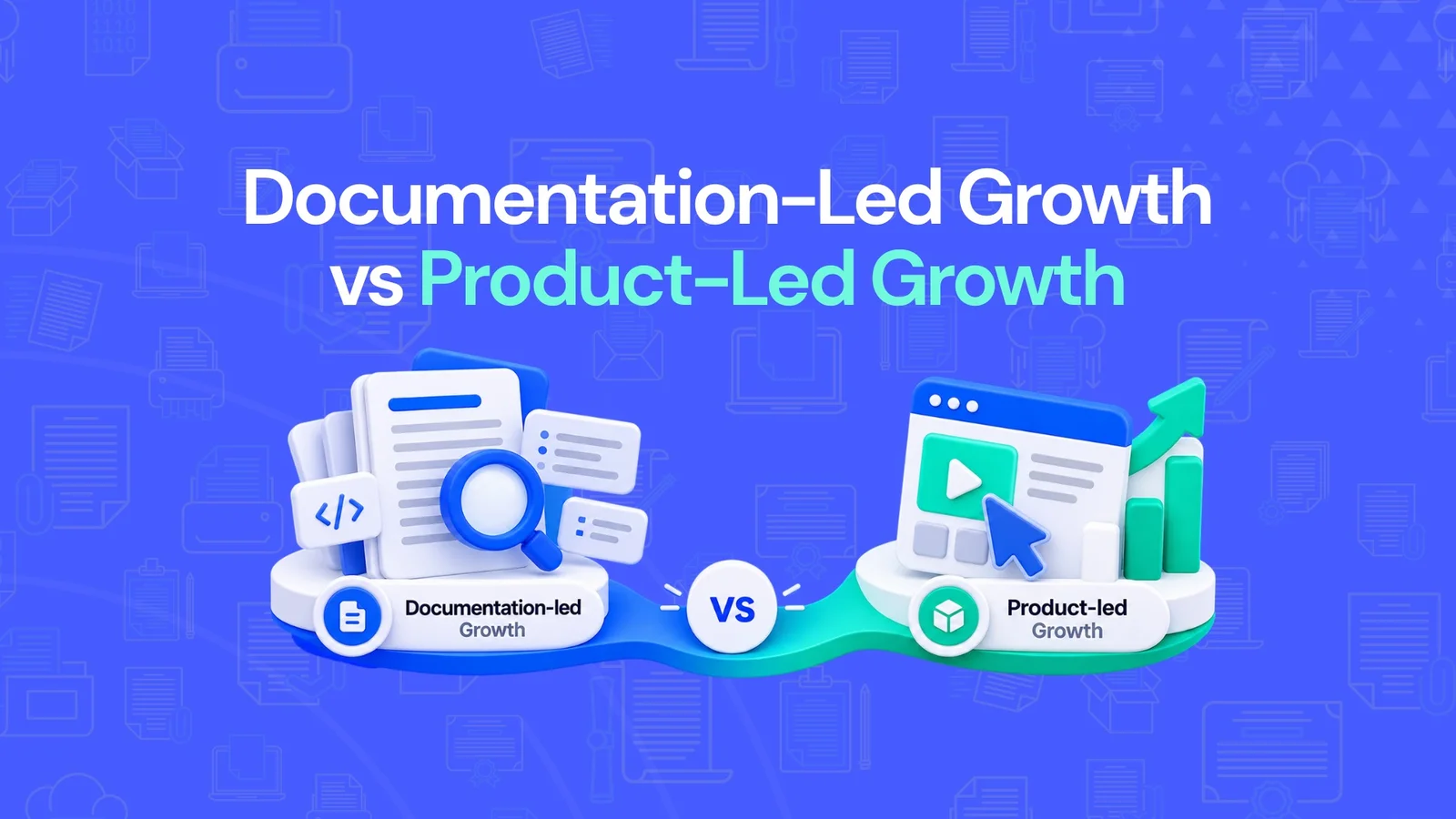



Documentation-led growth vs product-led growth comes down to where customers first find value. Documentation-led growth (DLG) attracts and educates prospects through public product documentation. Product-led growth (PLG) uses product experiences to drive adoption, conversion, and expansion. Together, documentation helps people discover a solution while the product proves its value.
Quick answer: DLG turns useful answers into an acquisition channel; PLG turns product usage into growth. DLG emphasizes discovery before signup, while PLG emphasizes activation and ongoing value. They complement rather than replace each other.
What is documentation-led growth, and what is product-led growth?
Both approaches help users solve problems, but start in different places.
What is documentation-led growth (DLG)?
Documentation-led growth makes public product documentation useful before someone becomes a customer. It provides accurate guides for questions about integrations, automation, troubleshooting, and feature evaluation.
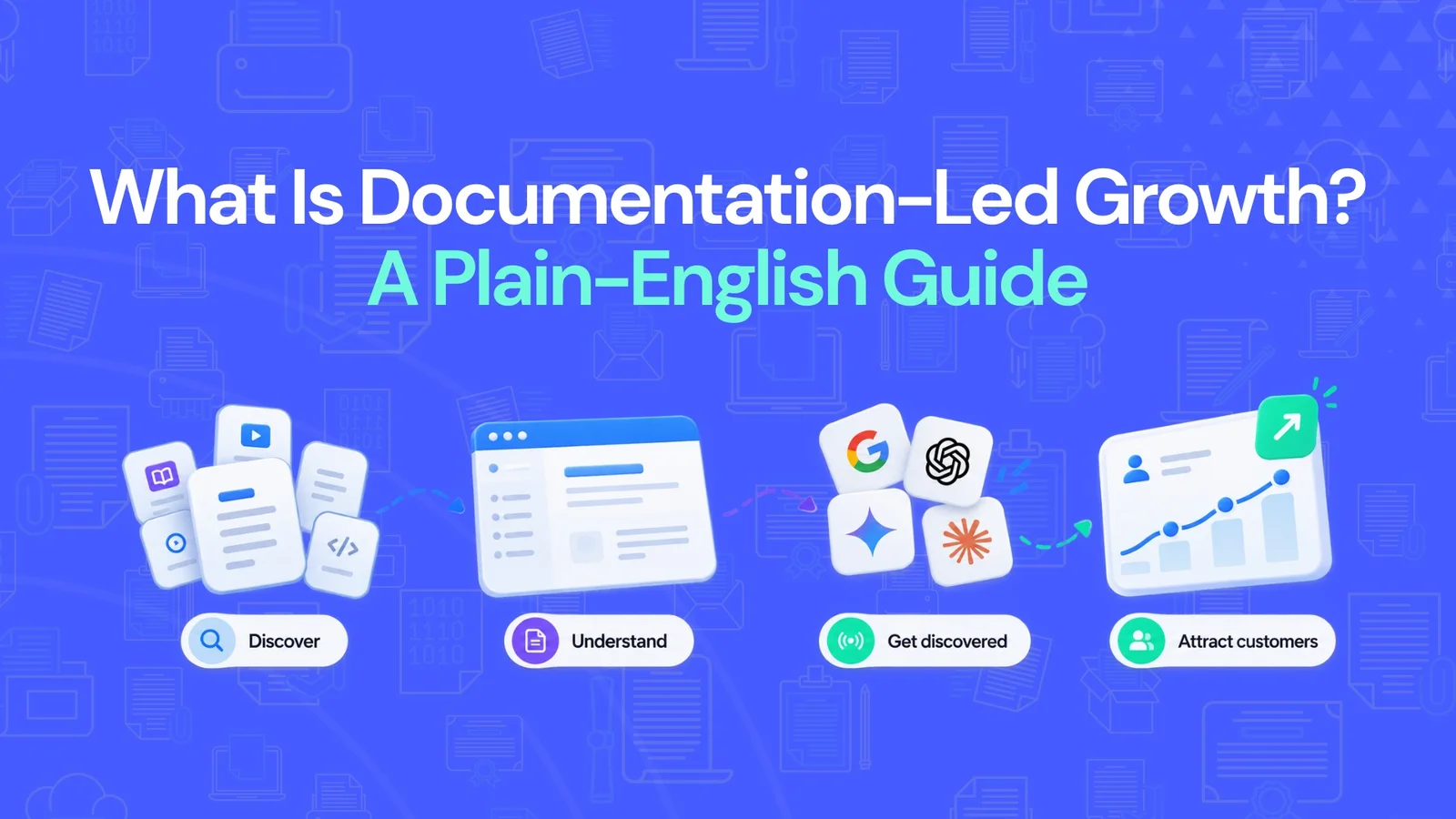
People may discover these guides through Google or AI-powered tools. Each page should answer the question, explain product fit, and offer a relevant next step. DLG is a developing term, not a universally standardized framework. For a deeper introduction, explore our plain-English guide to documentation-led growth.
What is product-led growth (PLG)?
Product-led growth uses the product itself to drive acquisition, activation, retention, and expansion. Users experience value through self-service onboarding, trials, or freemium access rather than a mandatory sales call.
As ProductLed explains, the key is helping users reach a meaningful result inside the product, then making continued use or upgrading a natural next step.
How are documentation-led growth and product-led growth different?
The central difference is the growth engine: DLG uses helpful answers as a discovery channel, while PLG uses product experience as a conversion and expansion engine.
| Dimension | Documentation-led growth (DLG) | Product-led growth (PLG) |
|---|---|---|
| Primary asset | Public guides, API docs, integration help, tutorials | Working product, onboarding, free experience |
| Typical entry point | Search query, shared guide, or AI-referenced answer | Trial, free account, invite, or product sharing |
| Core mechanism | Answer a problem and build confidence before signup | Deliver value through direct product use |
| Main audience | Prospects, evaluators, developers, and customers | Trial users, customers, and collaborating teams |
| Primary owners | Documentation/content, SEO, product experts | Product, growth, engineering, customer success |
| Key metrics | Qualified docs entrances, docs-to-signup conversion | Activation, time to value, retention, paid conversion |
| Main risk | Traffic without relevant product adoption | Signups that never reach meaningful value |
| Best outcome | The right user discovers a relevant solution | The user succeeds and keeps using the product |
DLG does not turn every help article into a sales pitch. PLG does not eliminate marketing, documentation, or sales.
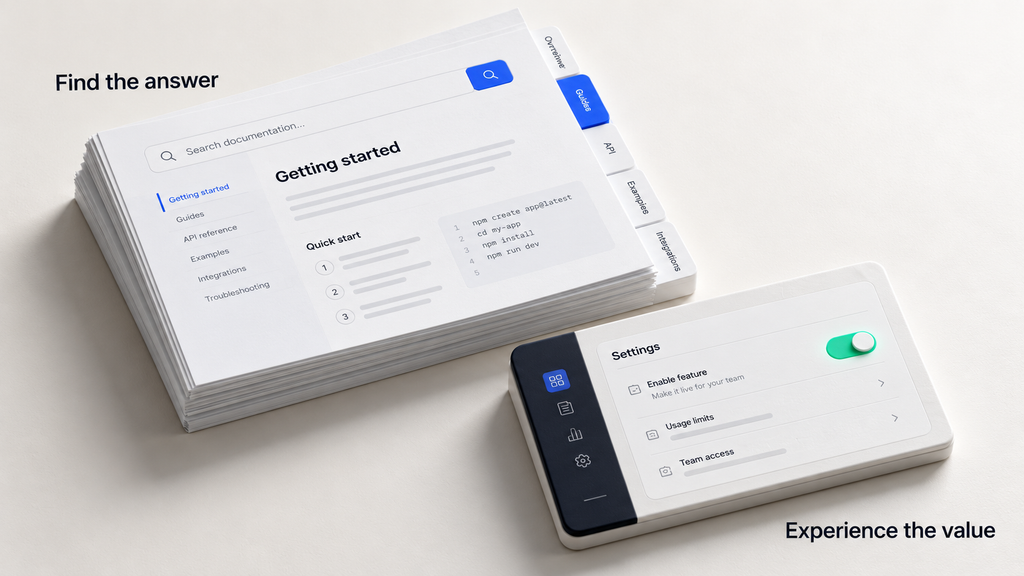
How does each strategy attract and convert customers?
DLG starts with a question; PLG starts with a product interaction.
Documentation-led journey: Search for a solution → read a task-focused guide → understand product fit → open a relevant trial or demo → complete the task.
Product-led journey: Start a trial → follow onboarding → complete a valuable action → keep using the product → upgrade or invite teammates.
A 2019 study of software-engineering searches analyzed one million search sessions, including documentation, installation, and debugging needs. It illustrates why task-focused answers can reach people before they visit a product homepage, though it does not prove acquisition impact.
Match the next step to the question. An integration guide should link to integration setup, not a generic sales page.
What does combining DLG and PLG look like in a SaaS company?
An e-commerce SaaS company can use docs to attract a problem-aware buyer, then its product to deliver the promised result.
For businesses serving online stores, documentation SEO for e-commerce software helps connect merchant questions about integrations and workflows with relevant product documentation.
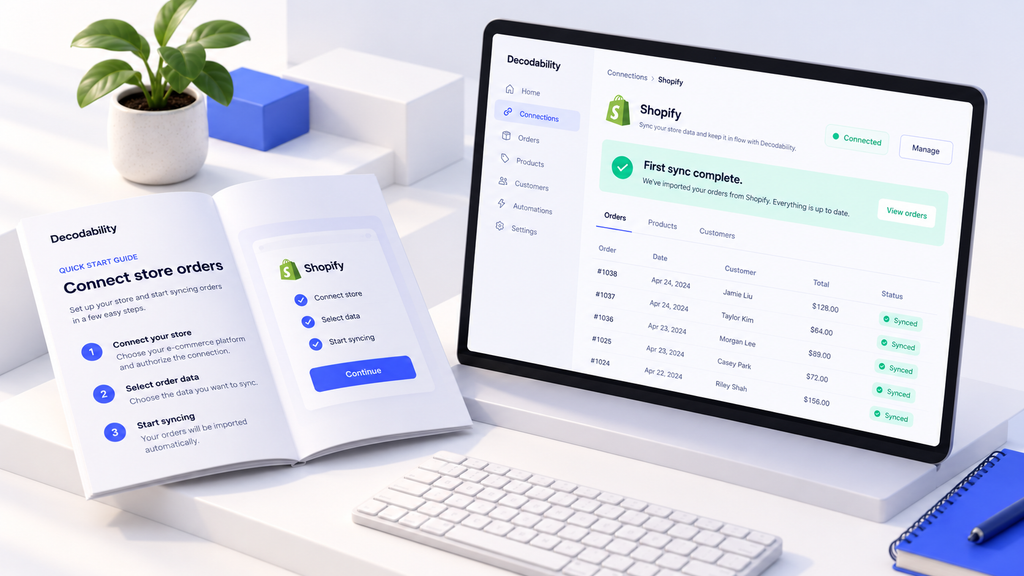
Imagine SyncLayer, a fictional SaaS tool that syncs Shopify order data to reporting tools. A store operator searches, “How do I automatically send Shopify orders to Google Sheets?”
- Discovery: The operator finds SyncLayer’s public guide with prerequisites, screenshots, limitations, and setup steps.
- Evaluation: The guide shows the supported workflow and links directly to a relevant free trial.
- Activation: After signup, an onboarding checklist helps the operator complete their first successful sync.
- Expansion: Once the workflow is reliable, the operator considers a paid plan for higher volume or additional automations.
Here is a hypothetical monthly funnel, included only to show how measurement works:
| Stage | Illustrative count |
|---|---|
| Qualified visits to the guide | 1,000 |
| Clicks from the guide into the product | 60 |
| Trial signups from those clicks | 20 |
| Users completing their first sync | 12 |
| Accounts upgrading to paid | 3 |
These are invented illustrative numbers, not research or forecasts. Track the full journey rather than celebrating traffic alone.
Who owns each strategy, and which metrics matter?
DLG relies on content, product, and engineering; PLG coordinates the in-product journey across growth, product, and customer success.
For DLG, documentation owns useful answers, subject experts ensure accuracy, and SEO or growth measures discovery. Track:
- Non-branded search entrances to public documentation.
- Relevant docs-to-trial or docs-to-demo conversion.
- Signup cohorts originating from documentation.
- Product activation among documentation-sourced users.
- Documentation accuracy, freshness, and assisted support outcomes.
For PLG, track activation rate, time to value, trial-to-paid conversion, retention, and expansion. GitLab’s growth handbook illustrates a self-service funnel from acquisition to activation and first orders.
Use Google Search Console, web analytics, and a product analytics tool such as Amplitude. Respect consent and attribution limits: a search visit or AI mention is not automatically a customer.
When should a SaaS company prioritize DLG or PLG?
Prioritize the weakest part of your customer journey.
| Current situation | First priority | Reason |
|---|---|---|
| Strong product, few relevant prospects discover it | DLG | Improve qualified discovery and education |
| Plenty of trials, but few users complete a core task | PLG | Fix activation before adding more traffic |
| Complex integrations create questions before signup | DLG + PLG | Answer questions, then guide successful setup |
| Good activation, weak retention | PLG | Improve recurring product value and usage |
| Enterprise buyers need reviews and sales support | Hybrid | Use docs for evaluation, product for proof, and sales where needed |
More search traffic cannot fix broken onboarding. Excellent onboarding cannot help buyers who never discover the product.
How can documentation and product experiences reinforce each other?
Combining DLG and PLG creates a feedback loop between discovery, product use, and improved answers.
- Search questions reveal unmet user needs and unclear product concepts.
- Public docs help prospects assess fit before signup.
- Onboarding deep-links to the exact guide needed for the next action.
- Product-event data shows where users become confused or drop off.
- Documentation is updated to address those obstacles, then performance is measured again.
When preparing documentation for AI search,, keep integrations, requirements, and limitations clear and current. Google says foundational SEO still applies; no special AI schema is required. Rankings and citations are never guaranteed.
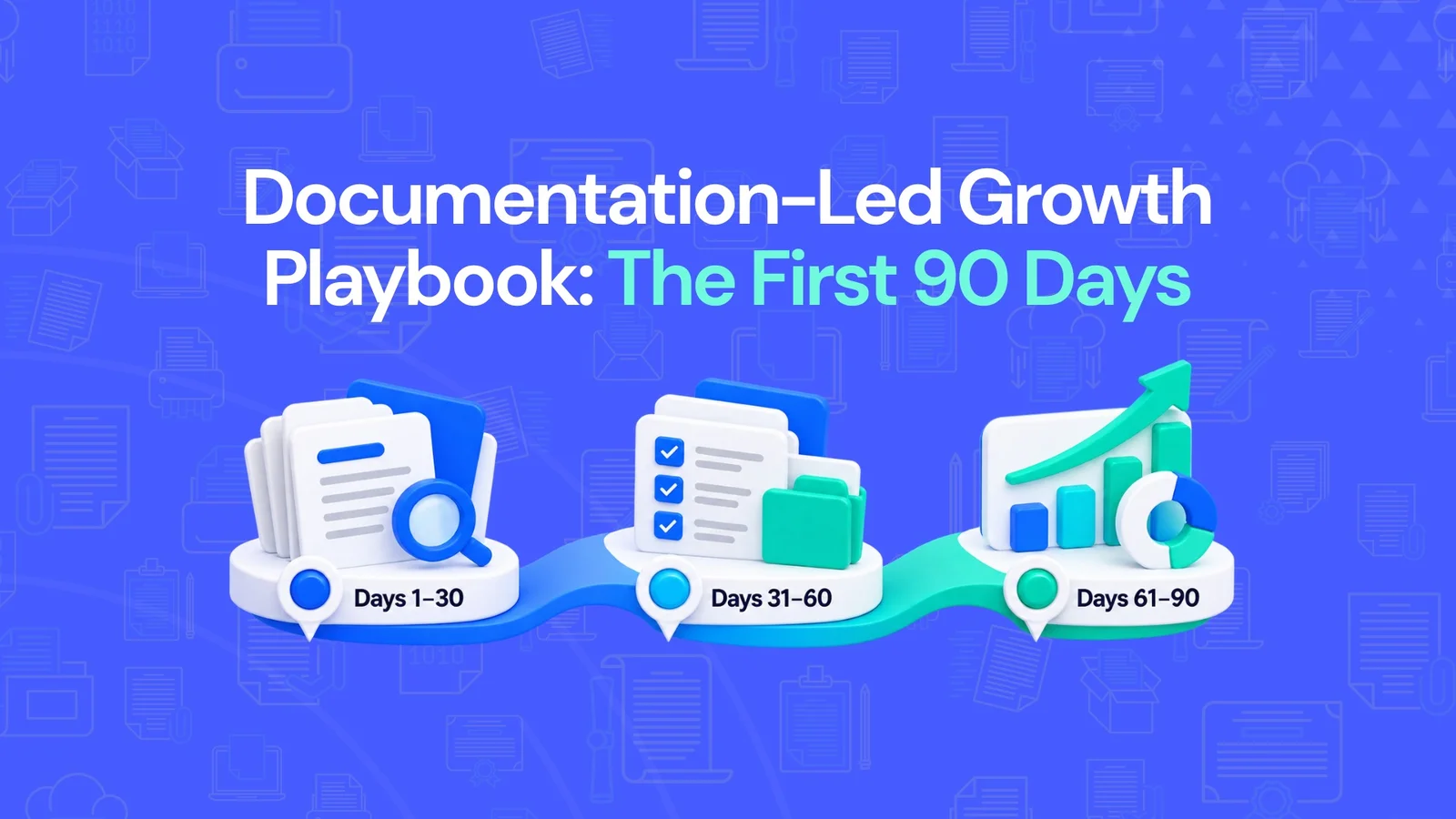
How can a SaaS team get started in 60 days?
Start with one high-intent task, one relevant documentation path, and one measurable activation event.
- Days 1–5, Decode: Audit public docs, search queries, customer questions, and existing conversion paths.
- Days 6–14, Structure: Choose important tasks, establish page hierarchy, assign owners, and define the product activation event.
- Days 15–30, Rebuild: Publish or update the highest-value guides with tested instructions, examples, internal links, and relevant product CTAs.
- Days 31–60, Launch and learn: Check indexing, track qualified entrances and activation, fix content gaps, and revise underperforming journeys.
At Decodability, we help marketing and e-commerce software companies make existing docs easier to discover, understand, and use. The goal is a clearer path from a real question to product value.
Frequently Asked Questions
Is documentation-led growth part of product-led growth?
Documentation-led growth can support product-led growth, but it is not automatically a subset of it. DLG focuses on finding and educating people through documentation; PLG focuses on helping people experience and expand value through the product.
Can documentation-led growth work without a free trial?
Yes. Public docs can support research, evaluation, and demo requests even when the product requires a sales-assisted purchase. The conversion step should match the buying process.
Which metrics best show documentation-led growth is working?
Focus on qualified documentation entrances, documentation-to-signup or demo conversions, and activation among documentation-sourced accounts. Pageviews alone cannot establish business impact.
Does product-led growth mean offering a freemium plan?
No. A free trial, limited sandbox, or other self-service experience can support PLG. What matters is whether users can experience meaningful value through the product.
Can documentation appear in AI-generated answers?
Public, accessible documentation can be eligible for discovery and citation in some AI-powered search experiences, but inclusion depends on each platform’s systems and is never guaranteed. Clear, accurate, original answers remain a sensible foundation.
Which growth approach should your SaaS business choose?
Choose DLG for discovery problems and PLG for activation, retention, or expansion problems. When both matter, connect public answers to a product experience that proves value.
Want to make your existing docs an acquisition channel? Explore Decodability’s 60-day documentation transformation process to see how we research, restructure, rebuild, and launch growth-ready documentation.